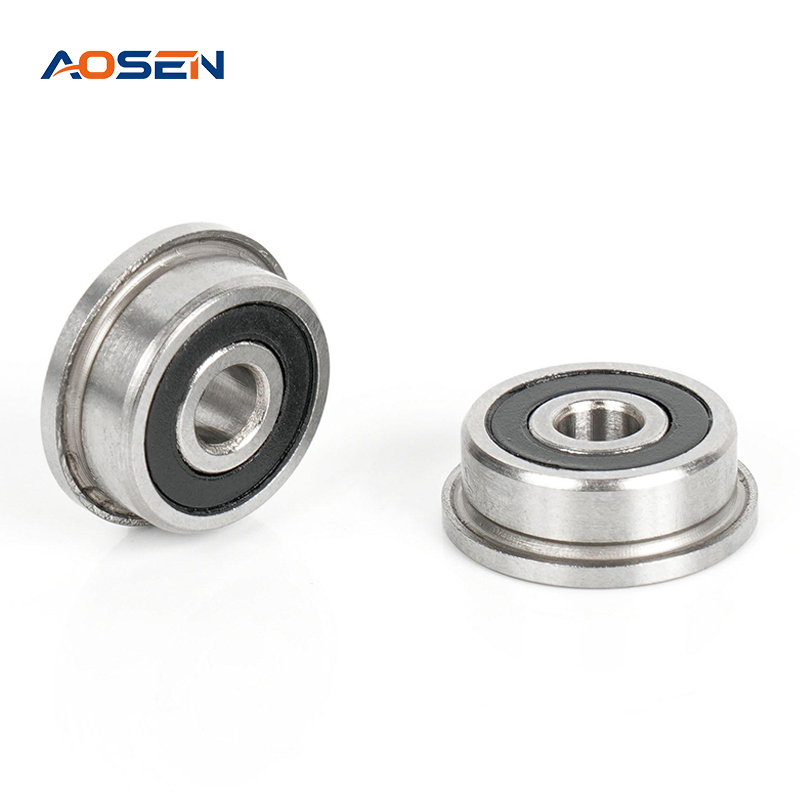
Flange Bearings solve a recurring machine design problem: how to mount a radial ball bearing without machining a precise housing step. The integral flange on the outer ring bolts directly to the mating part, gives accurate axial location and shortens assembly time. Ningbo Aosen Bearing Co., Ltd. manufactures flanged deep groove ball bearings in our own factory in Ningbo, China, and supports global OEM and distribution programs as a Flange Bearings manufacturer with full configuration support.
A Compact Mounting Solution Built on the Deep Groove Platform
Flange bearings use the same material, heat-treatment and grinding platform as our deep groove ball bearing production, so the rolling core is a proven, standardized design. What changes is the outer ring geometry: an extended flange that provides positioning, mounting and, in sealed versions, protection for the internal raceway.
- Single-flange versions locate the shaft axially in one direction.
- Double-flange versions capture the bearing between two faces for assemblies that must resist axial displacement in either direction.
- Sealed or shielded versions add environmental protection without changing the flange envelope.
Both flange formats remove the need for a separate bearing housing and reduce installation errors. For standard, non-flanged radial bearings, see our Deep Groove Ball Bearings range.
Flange Bearing Range and Application Fit
We produce flange bearings in the configurations most often requested for compact machinery, and we adapt flange geometry when the mounting pattern requires it. The table below maps each form to its typical operating environment.
| Bearing Form |
Design Description |
Typical Application Fit |
| Single-flange bearing |
One integral flange on the outer ring |
Automation equipment, light industrial machinery, compact gear trains |
| Double-flange bearing |
Flanges on both sides of the outer ring |
Precision instruments, high-speed light-load assemblies |
| Sealed flange bearing |
ZZ metal shields or 2RS rubber seals |
Humid, dusty or washdown environments |
| Stainless steel flange bearing |
AISI 420 martensitic body; 304/316 available on request |
Food processing, medical devices, water treatment, marine equipment |
Our standard flange bearing is the SF623 ZZ/2RS Stainless Steel Flange Bearing, a miniature stainless steel flanged deep groove ball bearing. We operate as Wholesale Stainless Steel Flange Ball Bearing Suppliers for OEM volume programs and bearing distributors, and we produce related flange formats on request.
Material, Sealing and Lubrication Options
The operating environment decides the correct material and seal, so we configure these parameters before quoting rather than treating them as afterthoughts. The SF623 shares the same metallurgy and process platform as our Stainless Steel Deep Groove Ball Bearings.
- AISI 420 martensitic stainless steel combines high hardness and wear resistance with rust protection for humid or mildly acidic/alkaline conditions.
- Other stainless grades such as AISI 440/440C, 304 and 316 are available when corrosion resistance or washdown chemicals demand a different metallurgy.
- GCr15 bearing steel covers standard industrial applications without corrosion exposure.
- ZZ metal shields suit low-friction, high-speed operation and block large particles.
- 2RS rubber seals in nitrile (NBR) or fluororubber (FKM) provide water and dust protection; FKM adds temperature and chemical resistance.
- Grease customization covers standard industrial grease, food-grade grease (FDA/NSF), high/low temperature and low-noise formulations.
Critical Specifications and Performance Data
The SF623 gives a clear baseline for the flange bearing line. Final ratings depend on processing accuracy and the selected seal, grease and clearance.
- Bore 3 mm; outside diameter 10 mm; width 4 mm
- Flange outside diameter 11.5 mm; flange thickness 1 mm
- Dynamic load rating Cr ≈ 640 N; static load rating Cor ≈ 230 N (reference values)
- Accuracy grades P0 (ABEC-1) and P6 (ABEC-3)
- Internal clearance C0 standard; C2 and C3 available
- Flange flatness and concentricity controlled during grinding to prevent vibration and noise
Flange Bearings vs Standard Deep Groove Bearings
The practical differences matter most at the design and assembly stage. We compare the two approaches in the table below.
| Feature |
Flange Bearings |
Standard Deep Groove Bearings |
| Installation |
Direct bolt mounting |
Requires housing |
| Positioning accuracy |
High, set by flange face |
Depends on housing accuracy |
| Installation efficiency |
Fast |
Moderate |
| Structure complexity |
Low |
Higher |
| Maintenance and replacement |
Easy, direct access |
More complex |
Manufacturing, Quality and Supply Stability
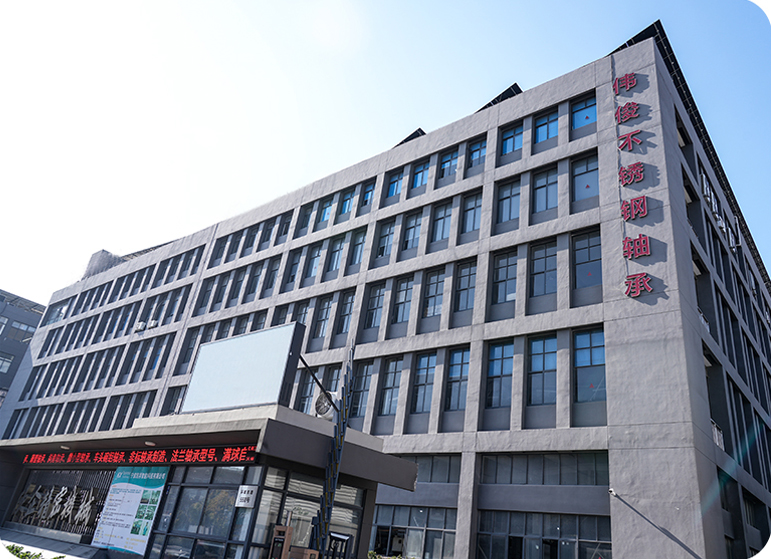
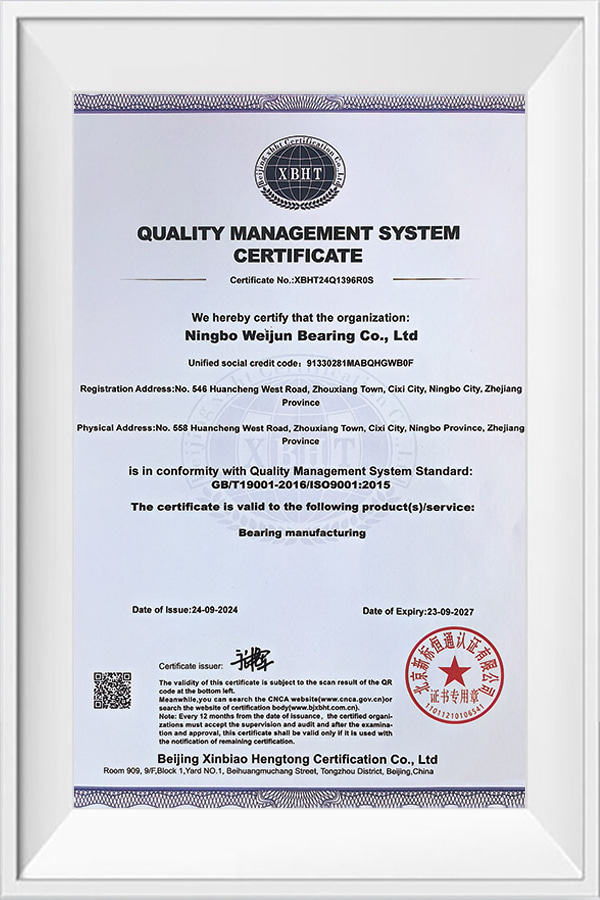
Production runs at our in-house facility, Ningbo Weijun Bearing Co., Ltd., which covers more than 8,000 square meters and produces 13–15 million bearing sets per year. Flange bearings follow the same process sequence as our deep groove series: material inspection, machining, heat treatment, grinding, assembly and final testing.
Critical parameters such as inner and outer diameters, roundness, flange flatness and visual quality are checked on dedicated inspection equipment. Because our own factory works directly with our export team, every order receives dual quality control before shipment — across prototype quantities and high-volume production alike.
Installation and Maintenance Considerations
Installation is the main advantage of this bearing type. The flange face sets the axial position and the bearing is fixed with bolts; the mounting face must be flat, clean and free of burrs so that tightening torque does not distort the outer ring.
Sealed 2RS versions are normally lubricated for life, while ZZ versions can be relubricated depending on speed and temperature. Because service means unbolting the flange rather than pressing out a housed bearing, replacement is faster and less disruptive on the production line.
Information We Use to Configure Your Solution
To prepare a configuration and quotation, we work from the following project data:
- Bearing model number or bore / outside diameter / width
- Flange outside diameter and flange thickness
- Radial and axial loads, speed and duty cycle
- Operating temperature, humidity, washdown or chemical exposure
- Seal preference: ZZ, 2RS NBR or FKM
- Lubrication: standard, food-grade, low-noise, high/low temperature
- Accuracy and internal clearance grade
- Estimated annual quantity and delivery schedule
- Drawing or sample for non-standard flange geometry
We confirm the selected configuration in the proposal, including dimensional, material, sealing and lubrication details.
Frequently Asked Questions
What is the difference between single-flange and double-flange bearings?
Single-flange bearings provide axial location in one direction and are the simpler choice for direct bolt mounting. Double-flange bearings locate both sides and suit precision assemblies that must resist axial displacement in either direction.
Which seal should we choose, ZZ or 2RS?
ZZ metal shields suit clean environments, lower torque and higher speed. 2RS rubber seals provide stronger water and dust protection; choose FKM when the bearing sees chemicals or elevated temperatures.
Can flange bearings be customized?
Yes. We adjust flange diameter, flange thickness, mounting hole geometry, material, seal, grease, accuracy and clearance. Non-standard bearings are developed from customer drawings or samples.
Are flange bearings suitable for food processing?
Stainless steel material, food-grade grease and FKM seals make them suitable for washdown and hygiene-sensitive equipment. We select the seal and lubricant according to the cleaning chemicals and temperatures used on your line.
What information do you need to prepare a flange bearing quotation?
Send the bearing dimensions or model number, flange dimensions, load and speed conditions, operating environment, seal and grease preference, and the estimated annual quantity. For modified designs, include a drawing or sample.
How does the flange improve installation?
The flange eliminates the need to machine a locating step in the housing. The bearing is positioned axially by the flange face and fixed with bolts, which reduces machining cost and improves assembly repeatability.


 Español