
 Español
What Are Angular Contact Bearings? A Complete Guide to Design and Selection
What Are Angular Contact Bearings?
When a pump impeller pushes against the liquid inside its casing, the shaft receives a steady axial thrust in addition to the radial forces created by rotation. A standard deep groove ball bearing accepts that radial load easily, but it is not designed to carry sustained thrust. The usual results are premature wear, rising noise, and raceway damage. This is the situation an angular contact bearing is built to solve.
Put in technical terms, an angular contact ball bearing is a ball bearing in which the inner and outer raceways are offset relative to each other, so that the line of contact between the balls and the raceways meets the shaft axis at an angle. Because of that angled contact path, part of the applied load is transferred along the bearing axis. The bearing can therefore support combined radial and axial loads in one direction, something a deep groove bearing of the same size cannot do for extended periods.
The contact angle, measured between the radial plane of the bearing and the line joining the contact points, is the central design parameter. Most angular contact ball bearings are produced with nominal angles of 15, 25, 30, or 40 degrees, and each value shifts the balance between axial load capacity and speed. Our guide to what an angular contact bearing does and how it differs from radial designs walks through the geometry in plainer language.
| Contact angle | Axial load capacity | Typical use |
|---|---|---|
| 15 degrees | Relatively low | Ultra-high-speed spindles where centrifugal effects dominate |
| 25 degrees | Moderate | General machine spindles, pumps, and gearboxes |
| 30 degrees | Moderate to high | Compressors and electric motors with steady thrust |
| 40 degrees | High | Heavy combined loads at slow to medium speeds |
How Angular Contact Bearings Work
Instead of the ball sitting centrally in a continuous groove, the ball is held in a fixed angular position between two offset raceways. When the shaft pushes axially, the thrust travels through the contact angle to a raceway shoulder that has been machined to receive it. Radial load is still carried in the normal way, so one bearing performs both functions at the same time.
The important limitation is that a single-row angular contact bearing supports axial load in one direction only. If the thrust reverses, the balls lose their defined contact path, and the bearing must be arranged as a matched pair. The three standard arrangements are back-to-back (DB), face-to-face (DF), and tandem (DT). DB and DF pairs handle thrust in both directions, while tandem pairs are selected when the load is very high in one direction.
Preload is the other defining characteristic. In spindle applications, the internal clearance is deliberately removed and a controlled compression is set between the balls and the raceways. That increases stiffness, improves running accuracy, and prevents ball skidding at high speed. Factory-matched pairs are measured together so that the preload is identical on both bearings, which is why pairing two separately purchased single bearings rarely gives the same result. Our explainer on how ball bearings transmit load through angular contact designs covers the load path in more detail.
Angular Contact vs. Deep Groove Ball Bearings
Design Differences
A deep groove ball bearing has a continuous deep raceway arc in both rings, and the ball sits centrally with an effective contact angle close to zero. An angular contact bearing has displaced raceways that force the ball to touch at a defined point on its surface. That offset creates the load triangle that makes axial load transfer possible.
Load Capacity and Rigidity
In a deep groove bearing, axial capacity is limited because the ball has to climb the shallow side of the raceway under sustained thrust, which stresses the cage and generates heat. An angular contact bearing is machined so that the raceway shoulder supports the ball directly. Axial capacity therefore rises with the contact angle, and the rigidity of a factory-matched pair is substantially higher, which is why angular contact bearings dominate machine tool spindles.
Speed and Temperature Behaviour
A 15-degree angular contact bearing runs nearly as fast as a deep groove bearing of the same series, because the load path stays close to the radial plane. As the contact angle increases toward 40 degrees, internal rolling friction grows and the top speed drops. In machine tools and pumps that trade-off is usually acceptable, because stiffness and thrust capacity matter more than the last few hundred rpm.
| Characteristic | Deep Groove Ball Bearing | Angular Contact Ball Bearing |
|---|---|---|
| Raceway geometry | Continuous deep groove | Offset raceways forming a defined contact angle |
| Contact angle | Nominally zero | Typically 15 to 40 degrees |
| Axial load, one direction | Limited | High, depending on the contact angle |
| Axial load, both directions | Possible in light duty | Single row handles one direction; pairs required for reversing thrust |
| Mounting | Individual bearing | Often a factory-matched pair or set |
| Rigidity with preload | Moderate | Excellent |
Where Angular Contact Bearings Are Used
Angular contact bearings appear wherever a machine combines a radial load with a defined thrust. The best-known example is the machine tool spindle, where they are often simply called spindle bearings, but the same design supports many other industrial roles.
- Machine tool spindles: the combination of high stiffness, low runout, and controlled preload keeps cutting operations accurate.
- Centrifugal and vertical pumps: the impeller produces steady axial thrust that the bearing carries along with the radial load.
- Compressors: reversing axial loads require DB or DF pairs, and the high rigidity keeps vibration low.
- Gearboxes and speed reducers: helical gears generate axial forces, and angular contact bearings absorb them without excessive clearance.
- Electric motors: vertical motors and traction motors use the design to manage rotor weight and magnetic pull.
- Automotive and robotic systems: steering components and robot joints use the same bearing geometry where positioning accuracy is critical.
In many machines, angular contact and deep groove bearings work side by side: the deep groove bearing handles a purely radial position, while the angular contact bearing manages the thrust position. Understanding that division of work is the first step in any bearing selection exercise.
Selecting the Right Angular Contact Bearing
Start with the axial load. Identify its direction, whether it reverses, and whether it is constant or shock-loaded. This single decision fixes both the contact angle and the mounting arrangement.
Then match the series to the shaft diameter and the total load. The three common metric series follow the same logic as deep groove ball bearings. 7000 series angular contact ball bearings are the light series, intended for small shafts and high speeds. 7200 series angular contact ball bearings cover the medium-duty middle ground seen in pumps, general motors, and light gearboxes. 7300 series angular contact ball bearings are built for larger shafts and substantial combined loads.
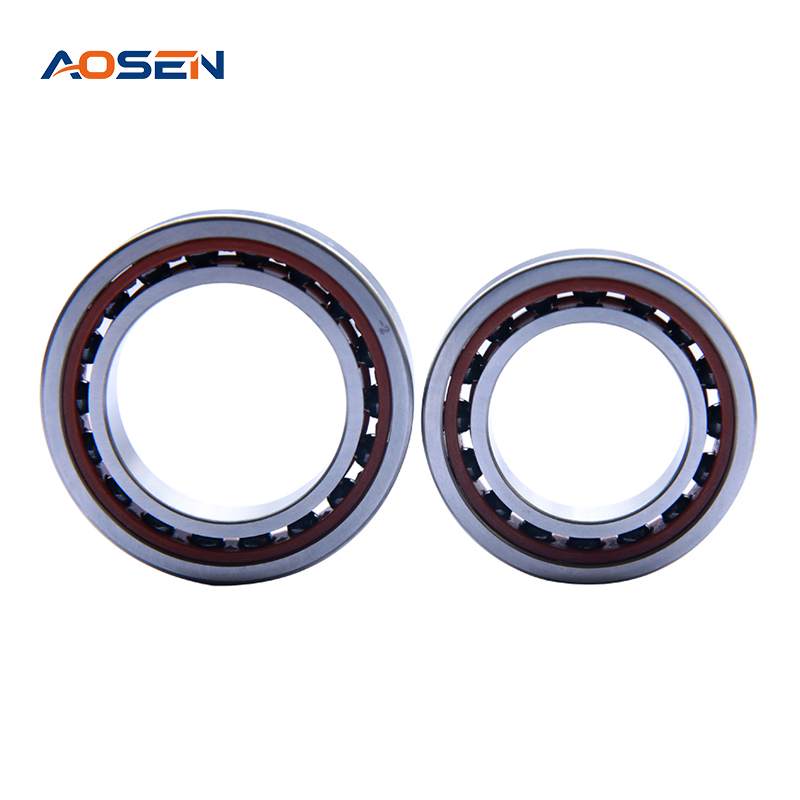 Wholesale 7300 Series Angular Contact Ball Bearings Exporter, Suppliers, FactoryNingbo Aosen Bearing Co., Ltd. is China wholesale 7300 Series Angular Contact Ball Bearings suppliers,exporter and bearings factory, The ...View Product →
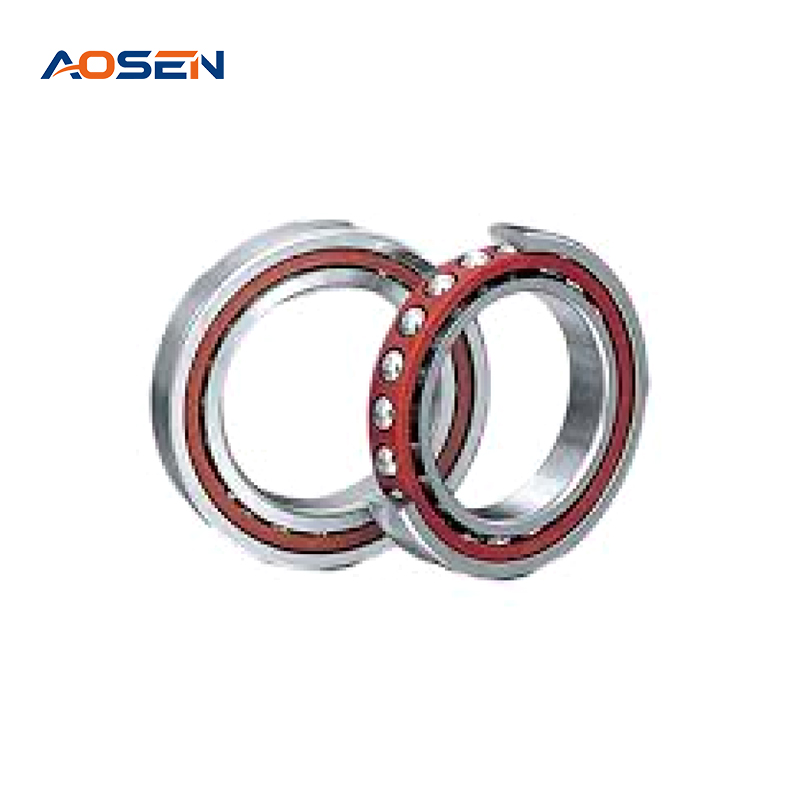 Wholesale 7200 Series Angular Contact Ball Bearings Exporter, Suppliers, FactoryNingbo Aosen Bearing Co., Ltd. is China wholesale 7200 Series Angular Contact Ball Bearings suppliers,exporter and bearings factory, The ...View Product →
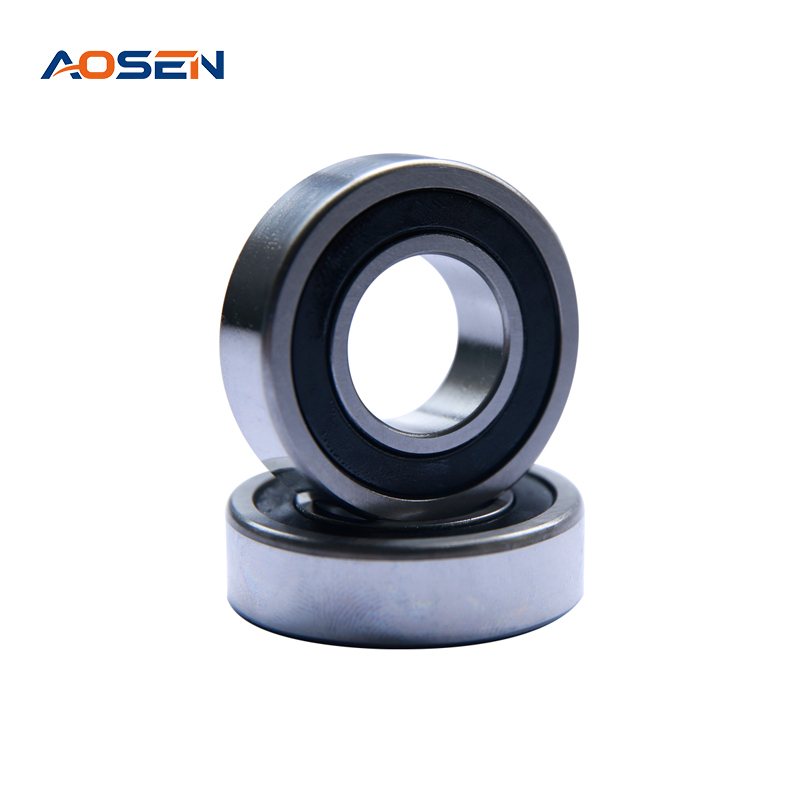 Wholesale 7000 Series Angular Contact Ball Bearings Exporter, Suppliers, FactoryNingbo Aosen Bearing Co., Ltd. is China wholesale 7000 Series Angular Contact Ball Bearings suppliers,exporter and bearings factory, The ...View Product →
Next, choose the cage material and sealing. Brass cages are preferred for high speed and vibration; steel cages offer strength and are common in the heavier series; polyamide cages give quiet running at moderate speeds. Open bearings dominate the angular contact world because spindle applications rely on oil or oil-air lubrication, but sealed versions exist where grease life is the deciding factor.
Finally, decide the preload class and the running accuracy grade. Light preload suits high speed; medium preload suits pumps and general machinery; heavy preload delivers maximum rigidity at the cost of top speed. Standard tolerance grades cover most industrial duty, while P5 and better grades belong in spindles and measuring equipment. Our guide to choosing among ball bearing types compares these options against other bearing families.
One procurement rule matters more than any other: buy angular contact bearings as factory-matched pairs or sets whenever the design requires a preloaded arrangement. Single units from different batches can differ slightly in internal dimensions, and the stiffness of the finished assembly depends on identical preload on both sides.
Sourcing and Quality Considerations
The quality of an angular contact bearing is fixed before it leaves the factory. Raceway grinding accuracy, ring roundness, ball grade, cage consistency, grease cleanliness, and the measured contact angle all determine how the bearing behaves at speed. A reliable supplier should be able to document these parameters rather than simply quoting a catalogue number.
Confirm the pairing policy as well. Matched sets should be measured from the same batch, with the width deviation and preload value recorded. If a supplier cannot explain how pairs are matched, treat the delivered preload as a variable in your design.
It also pays to look at the factory behind the catalogue. An exporter backed by its own manufacturing plant can control dimensional inspection, runout testing, noise and vibration checks, and final lubrication. That is the model at our facility: the angular contact and deep groove ranges are produced in-house under double quality control and exported directly, which gives customers a single partner for engineering answers, product consistency, and export logistics. Tolerances, cage options, and surface treatments can be adjusted for OEM projects, and customers are welcome to audit the facility.
In short, angular contact bearings earn their place wherever axial load appears: spindles, pumps, compressors, gearboxes, motors, and precision machinery. Choose the contact angle carefully, respect the single-direction rule, buy matched pairs, and verify the supplier's quality data. A well-specified angular contact bearing pays for itself in uptime and long-term accuracy.



-

-
 +86-15990593443
 -
 No. 558 Huancheng West Road, Zhouxiang Town, Cixi City, Ningbo Province, Zhejiang Province

- Quick Links
- Product Categories
- Deep Groove Ball Bearings
- Stainless Steel Deep Groove Ball Bearings
- Angular Contact Ball Bearings
- Flange Bearings

Message Us Now !