What Is an Angular Contact Bearing
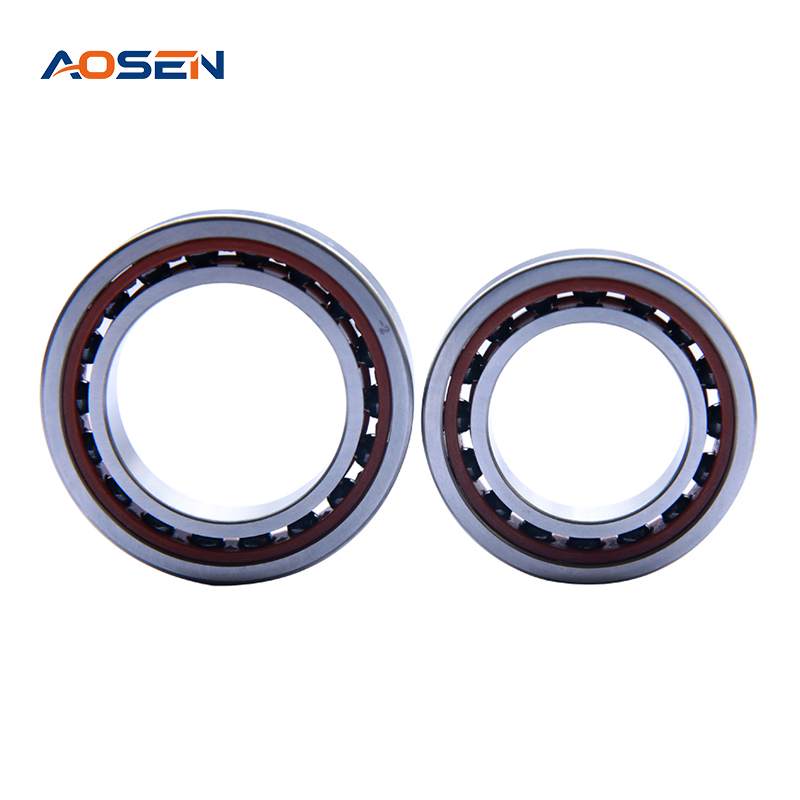
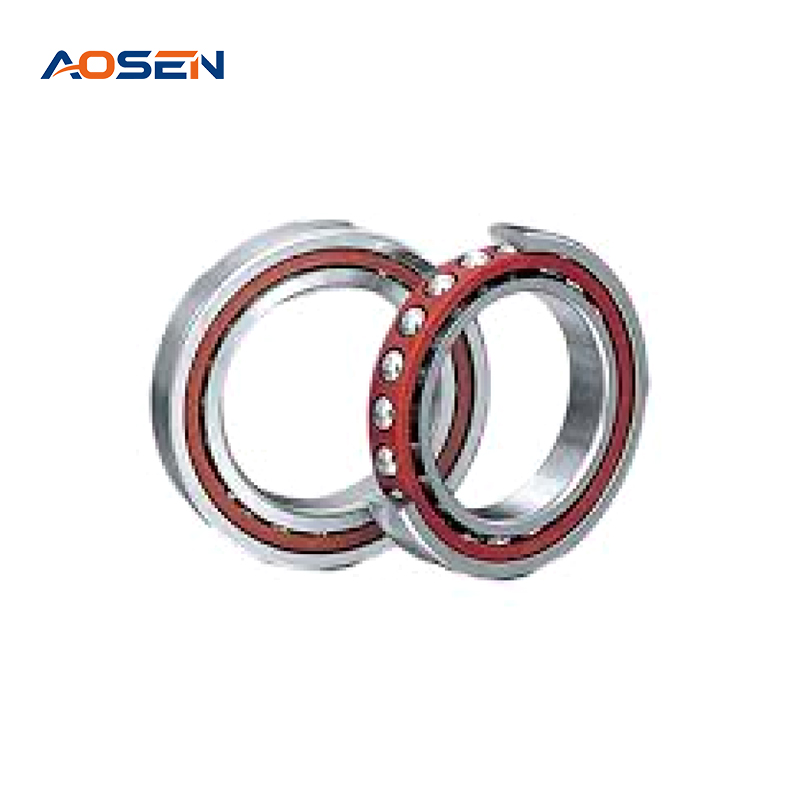
An angular contact bearing is a type of ball or roller bearing designed with raceways positioned at an offset angle to the bearing's axis, allowing it to support combined radial and axial (thrust) loads simultaneously rather than handling only one type of load like a standard deep groove bearing. This offset, called the contact angle, typically ranges from 15° to 40° and determines how much axial load the bearing can carry relative to radial load.
Angular contact ball bearings specifically use balls as the rolling element and are the most common form of this bearing type, widely used in machine tool spindles, pumps, and gearboxes where shafts experience thrust forces from gear meshing or fluid pressure alongside normal radial loads. A bearing with a 40° contact angle can support roughly twice the axial load of one with a 15° angle at the same bearing size, which is why selecting the correct contact angle is the first decision in any application.
How Angular Contact Ball Bearings Work
Inside a standard deep groove bearing, the inner and outer raceways are aligned so that contact between the ball and raceway happens directly across the radial plane. In an angular contact bearing, the raceways are ground asymmetrically so the line connecting the contact points on the inner and outer races forms an angle relative to the bearing's radial plane.
Why the Angle Enables Thrust Capacity
Because the load path runs diagonally through the ball rather than straight across it, a portion of any radial load is converted into an axial force component, and conversely the bearing can resist axial loads pushing the shaft in one direction. This is why angular contact bearings are almost always mounted in pairs or sets, since a single bearing only resists thrust in one axial direction.
One-Directional Thrust Limitation
A single angular contact bearing can only carry axial load pushing the shaft toward the side where the contact angle "opens." Reverse thrust will not be supported, which is the core reason these bearings are typically paired back-to-back or face-to-face in real assemblies.
Contact Angle Classes and Their Load Capacity
Manufacturers produce angular contact ball bearings in a few standardized contact angle classes, each suited to a different balance of speed and axial load capacity.
Standard contact angle classes and their typical performance characteristics
| Contact Angle |
Axial Load Capacity |
Typical Use |
| 15° (Series C) |
Low |
High-speed spindles, precision machine tools |
| 25° (Series A) |
Medium |
General industrial gearboxes, pumps |
| 30° (Series E) |
Medium-high |
Compressors, mixed load applications |
| 40° (Series B) |
High |
Heavy thrust applications, automotive front wheels |
As a general rule, lower contact angles support higher speeds because less of the ball's contact force is directed axially, reducing heat generation, while higher contact angles trade some speed capability for greater thrust load support.
Bearing Configurations and Mounting Arrangements
Because a single angular contact bearing only handles one-directional thrust, manufacturers supply them in pre-matched sets ground to fit together with the correct internal clearance. The configuration chosen affects rigidity, misalignment tolerance, and which directions of load are supported.
Common angular contact bearing mounting configurations
| Configuration |
Designation |
Best Suited For |
| Back-to-back |
DB |
Bidirectional thrust, moment loads, high rigidity |
| Face-to-face |
DF |
Bidirectional thrust, shaft misalignment tolerance |
| Tandem |
DT |
Heavy unidirectional thrust only |
| Universal match |
UA / UO |
Flexible field assembly in any combination |
Back-to-back (DB) arrangements are generally preferred for machine tool spindles because the wider effective center distance between the two bearings provides significantly higher resistance to shaft tilting under moment loads compared to a face-to-face setup.
Angular Contact Bearings vs Other Bearing Types
Engineers often compare angular contact ball bearings against deep groove ball bearings and tapered roller bearings when a shaft must handle both radial and axial loads.
Comparison of bearing types for combined radial and axial loading
| Bearing Type |
Speed Capability |
Axial Load Capacity |
| Deep groove ball |
High |
Low |
| Angular contact ball |
High |
Medium-high |
| Tapered roller |
Medium |
High |
Angular contact ball bearings sit in a practical middle ground: they tolerate speeds roughly 20-30% higher than tapered roller bearings of comparable size due to lower rolling friction, while still managing meaningful thrust load that deep groove bearings cannot handle reliably.
Common Applications of Angular Contact Ball Bearings
The combination of radial and thrust capacity with good high-speed performance makes angular contact bearings the standard choice across several industries.
- Machine tool spindles – 15° contact angle bearings in back-to-back pairs support cutting forces while maintaining the rotational accuracy needed for sub-micron precision
- Automotive front wheel hubs – 40° contact angle bearings handle cornering thrust loads alongside the vehicle's weight
- Centrifugal pumps and compressors – 25-30° bearings manage axial thrust generated by impeller pressure differentials
- Gearboxes with helical or bevel gears – angular contact sets absorb the inherent axial thrust these gear types generate during meshing
- Robotic arm joints and rotary tables – paired bearings provide the rigidity needed to resist tilting moments at the joint
Preload and Precision Class Selection
Two additional specifications determine how an angular contact bearing performs once installed: preload level and precision class.
Preload
Applying a small, controlled internal load (preload) when mounting the bearing pair removes internal play and improves rotational accuracy. Light preload suits high-speed spindle applications, while heavy preload is used where maximum rigidity matters more than top speed, such as in grinding machine spindles.
Precision Class
Bearings are graded under ISO or ABEC standards, with ABEC 7 or ABEC 9 (ISO P4/P2) classes reserved for high-precision spindle work, while standard ABEC 1 (ISO P0) bearings are sufficient for general industrial gearboxes and pumps where extreme rotational accuracy isn't required.
Installation and Maintenance Best Practices
Because matched bearing sets are ground as a pair, incorrect handling during installation is one of the most common causes of premature failure.
- Never mix bearings from different matched sets, since the internal clearance is ground specifically for that pair
- Confirm correct orientation markings (often an arrow or letter on the outer ring) before installation, as reversing a bearing in a back-to-back set converts it into an unintended face-to-face arrangement
- Apply mounting force evenly across the inner ring face using a sleeve or press, never tapping directly on the balls or cage
- Verify shaft and housing tolerances match the bearing manufacturer's fit recommendations, since an oversized housing bore can reduce the intended preload
- Re-lubricate at manufacturer-specified intervals; high-speed spindle bearings often require oil-air or grease-for-life systems rather than periodic manual greasing
Field data from bearing manufacturers consistently shows that improper preload setting accounts for a large share of early spindle bearing failures, more than material defects or normal wear, which is why torque-controlled installation procedures matter as much as bearing selection itself.
How to Choose the Right Angular Contact Bearing
Selecting the correct bearing comes down to matching contact angle, configuration, and precision class to the actual load and speed profile of the application.
- Calculate the expected ratio of axial to radial load; ratios above 0.5 generally call for a 30-40° contact angle rather than 15°
- Choose back-to-back (DB) mounting when moment load resistance and rigidity matter most, and face-to-face (DF) when some shaft misalignment is expected
- Match precision class to the application's accuracy requirement rather than defaulting to the highest available class, since unnecessarily tight precision adds significant cost without functional benefit in general industrial use
- Confirm the bearing's rated speed (often expressed as a dn value, bore diameter times RPM) comfortably exceeds the application's operating speed
- Work with a supplier that provides matched-set documentation and clear orientation markings, since unmarked or unmatched bearings are difficult to install correctly in the field
Getting these selections right at the design stage avoids the far more expensive problem of diagnosing premature bearing failure after a machine is already in service.

 Español

 +86-15990593443
 No. 558 Huancheng West Road, Zhouxiang Town, Cixi City, Ningbo Province, Zhejiang Province