Why Stainless Steel Deep Groove Ball Bearings Are the Go-To Choice for Demanding Environments
Stainless steel deep groove ball bearings are the most widely used bearing type in the world — and for good reason. Their deep-raceway geometry allows them to handle both radial and axial loads simultaneously, while stainless steel construction gives them resistance to corrosion, moisture, and chemical exposure that standard chrome steel bearings simply cannot match. For applications involving water, food, chemicals, or high humidity, stainless steel deep groove ball bearings are the standard engineering choice.
They are available in virtually every bore size from 1mm to over 150mm, run at high speeds with low friction, and require minimal maintenance when properly sealed. Understanding their construction, material grades, load ratings, and sealing options helps engineers and buyers select the right bearing for each application — and avoid the costly failures that come from the wrong choice.
How Deep Groove Ball Bearings Are Constructed
The "deep groove" in the name refers to the continuous raceway groove machined into both the inner and outer rings. This groove is deeper, relative to ball diameter, than in angular contact or thrust bearings — typically the groove radius is 51.5–53% of the ball diameter. That geometry is what enables the bearing to accommodate axial loads in both directions in addition to radial loads, without requiring a separate thrust bearing.
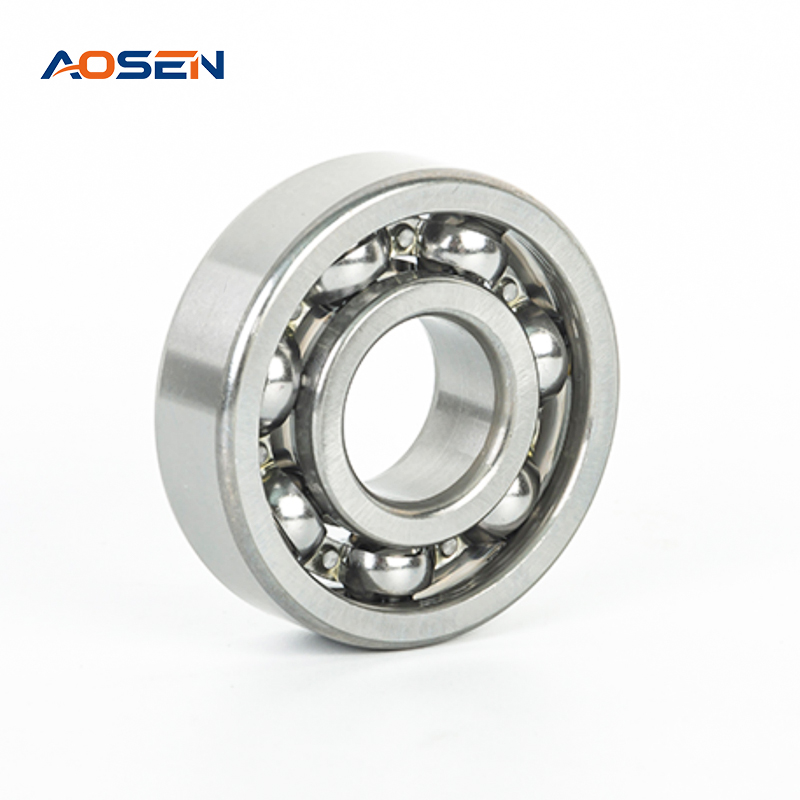
A standard deep groove ball bearing consists of four components:
- Inner ring: Fits onto the rotating shaft; carries the inner raceway groove.
- Outer ring: Fits into the housing bore; carries the outer raceway groove.
- Ball complement: Precision-ground steel balls that roll in the raceways and transmit load between rings.
- Cage (retainer): Keeps balls evenly spaced around the circumference to prevent contact between them and reduce heat and noise. Made from steel, brass, or PTFE depending on the application.
In stainless steel versions, the rings and balls are manufactured from corrosion-resistant steel alloys rather than through-hardened chrome steel (AISI 52100), which is the standard for general-purpose bearings. This distinction drives virtually every performance difference between the two types.
Stainless Steel Grades Used in Bearing Manufacturing
Not all stainless steel bearings are made from the same alloy. The grade used has a direct and significant impact on corrosion resistance, hardness, load capacity, and maximum operating temperature. Three grades dominate bearing production:
AISI 440C (Martensitic Stainless Steel)
The most common grade for stainless steel deep groove ball bearings. AISI 440C contains approximately 17% chromium and 1% carbon, which allows it to be heat-treated to a Rockwell hardness of 58–62 HRC — comparable to standard bearing steel. This hardness is essential for load-bearing capacity and fatigue resistance. The chromium content provides good corrosion resistance in mildly corrosive environments, though 440C is not suitable for prolonged immersion in seawater or strong acids.
AISI 316 (Austenitic Stainless Steel)
AISI 316 contains 16–18% chromium, 10–14% nickel, and 2–3% molybdenum. The molybdenum significantly enhances resistance to chloride pitting and crevice corrosion, making 316 bearings the standard for marine, pharmaceutical, and chemical processing applications where 440C would fail. The trade-off is hardness: 316 cannot be heat-treated to bearing-grade hardness and typically achieves only 25–35 HRC. This limits its static and dynamic load capacity to roughly 30–50% of 440C equivalents, so 316 bearings are reserved for lightly loaded, highly corrosive environments.
AISI 304 (General-Purpose Austenitic)
AISI 304 is the most widely produced stainless steel globally, but it is less commonly used in precision bearings than 440C or 316. It offers good general corrosion resistance but has lower chloride resistance than 316 and lower hardness than 440C. It appears primarily in cage components, shields, and housings rather than in the load-bearing rings and balls themselves.
| Grade |
Type |
Hardness (HRC) |
Corrosion Resistance |
Typical Use |
| AISI 440C |
Martensitic |
58–62 |
Good (mild environments) |
General stainless bearing applications |
| AISI 316 |
Austenitic |
25–35 |
Excellent (chlorides, acids) |
Marine, pharma, food, chemical |
| AISI 304 |
Austenitic |
20–30 |
Moderate |
Cages, shields, non-load parts |
Comparison of stainless steel grades commonly used in deep groove ball bearing manufacturing
Sealing and Shielding Options and What They Mean for Performance
The designation suffix on a bearing number tells you its sealing configuration — one of the most consequential choices for real-world bearing life. The three main options are:
Open Bearings (No Suffix)
Open bearings have no cover on either side. They allow free lubricant flow, making them suitable for applications with external lubrication systems or high-speed operation where heat dissipation is critical. However, they offer no protection from contamination, so they are only appropriate in clean, controlled environments.
Shielded Bearings (ZZ or 2Z)
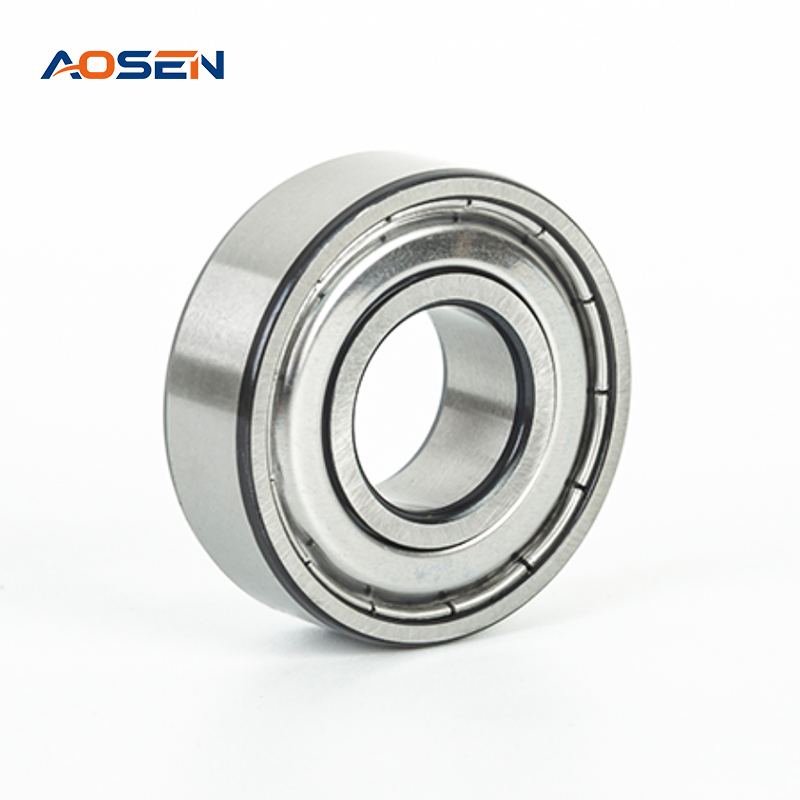
Metal shields are pressed into the outer ring groove on one or both sides. They are non-contact — there is a small running clearance between shield and inner ring — so they add virtually no additional friction or drag. They prevent large particles from entering the bearing but are not effective against fine dust, water, or liquid contamination. The ZZ designation means both sides are shielded. Shielded stainless bearings come pre-greased and are the best choice for high-speed, clean-but-uncontrolled environments.
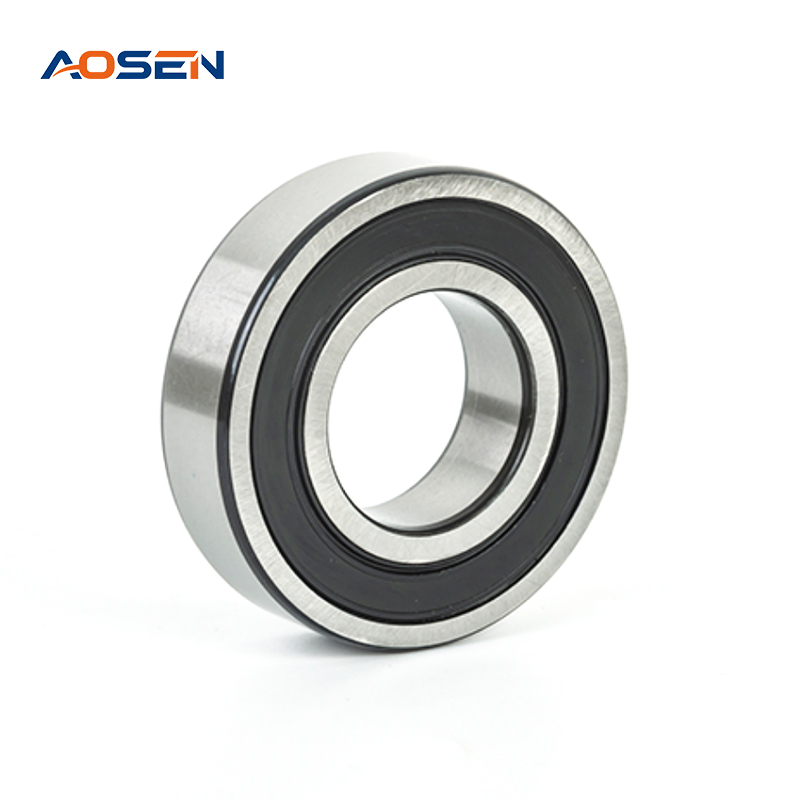
Sealed Bearings (2RS or RS)
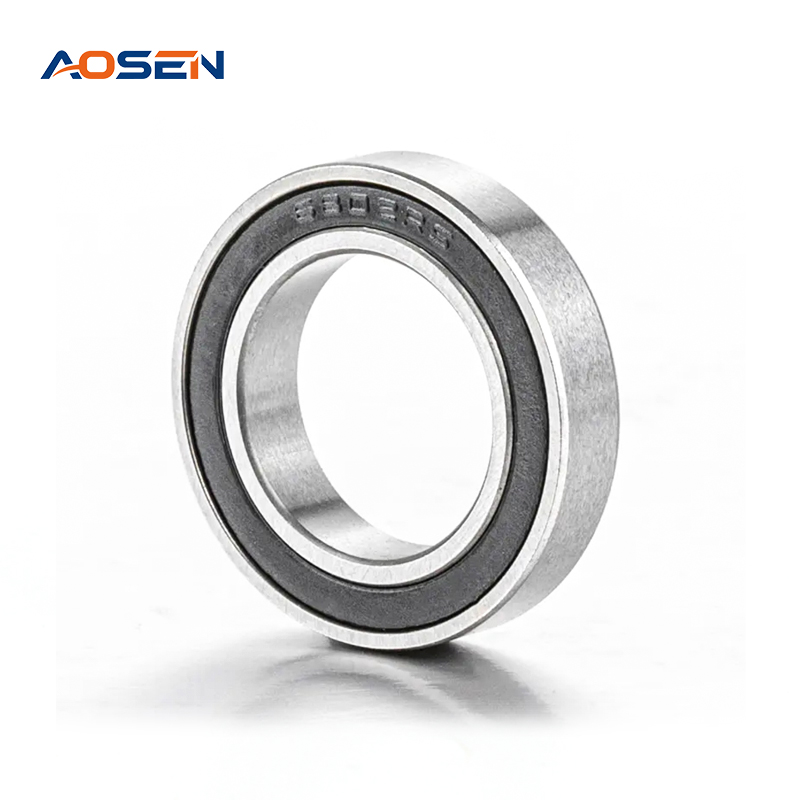
Rubber or synthetic contact seals run against a groove in the inner ring, providing far better exclusion of moisture, fine particles, and liquids than shields. The 2RS designation means both sides are sealed. The trade-off is a slight increase in friction torque — typically 2–5 times higher starting torque than shielded equivalents — and a modest reduction in maximum allowable speed. For stainless steel bearings used in wet, food processing, or chemical environments, 2RS sealing is almost always the correct choice. In corrosive service, the seal lip material should also be specified — Viton (FKM) seals outperform standard NBR rubber in oils, fuels, and many chemicals.
Load Capacity: How Stainless Steel Compares to Chrome Steel
The most important trade-off when specifying stainless steel over chrome steel is load capacity. Because stainless steel alloys — particularly 440C — are slightly softer and have different fatigue characteristics than AISI 52100 chrome steel, their dynamic and static load ratings are lower for equivalent bearing dimensions.
As a practical rule, 440C stainless bearings carry approximately 80–85% of the dynamic load rating (C) of an equivalent chrome steel bearing. For a common 6205 bearing, the chrome steel dynamic load rating is typically around 14.8 kN; a 440C stainless 6205 carries approximately 12–13 kN. This difference matters in high-load, high-cycle applications but is negligible in lightly loaded or intermittent service.
For 316 stainless bearings, the load capacity reduction is more severe — as much as 50–70% lower than chrome steel due to the much lower attainable hardness. These bearings should only be selected when the corrosion resistance of 316 is genuinely required and the load analysis confirms adequacy.
Common Bearing Series and Dimension Standards
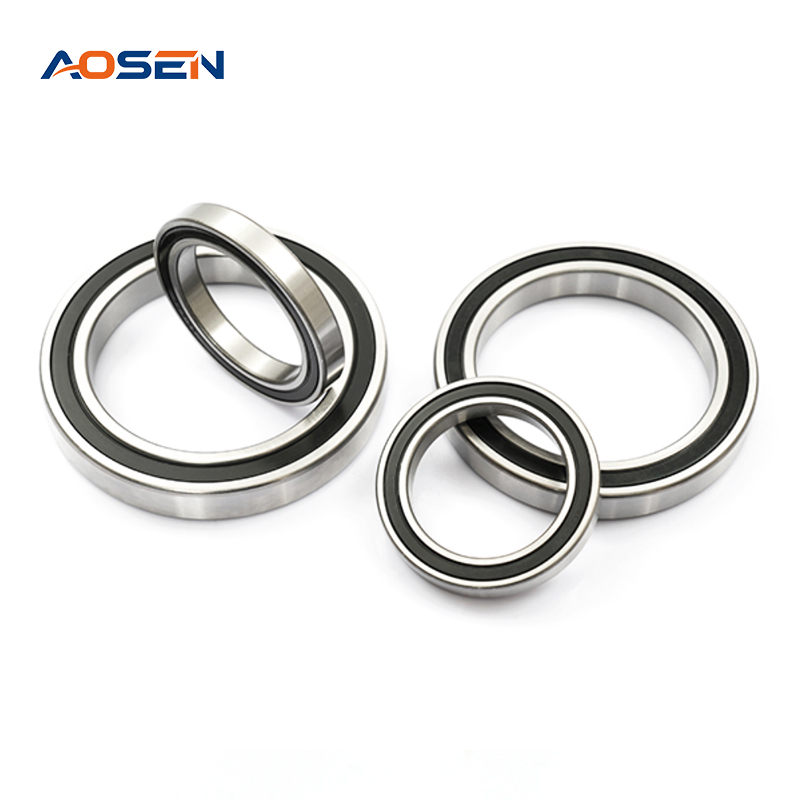
Stainless steel deep groove ball bearings follow the same ISO and ABEC dimensional standards as chrome steel bearings, making them interchangeable in housings and shaft designs without modification. The major series are:
| Series |
Width / Section |
Bore Range |
Typical Application |
| 600 Series |
Extra thin |
1–9 mm |
Micro motors, instruments, RC equipment |
| 6000 Series |
Thin section |
10–80 mm |
Motors, pumps, fans, light machinery |
| 6200 Series |
Light section |
10–90 mm |
General machinery, food equipment, pumps |
| 6300 Series |
Medium section |
10–150 mm |
Heavier loads, industrial equipment |
| 6800 Series |
Thin section |
10–90 mm |
Space-constrained designs, robotics |
Common deep groove ball bearing series with bore ranges and typical applications
The bearing number encodes its dimensions. For example, a 6205-2RS stainless bearing has a 25mm bore (inner diameter), 52mm outer diameter, and 15mm width — the same as any other 6205 regardless of manufacturer, following ISO 15 standards. The 2RS suffix indicates rubber seals on both sides.
Industries and Applications That Rely on Stainless Steel Deep Groove Ball Bearings
The corrosion resistance and versatility of stainless steel deep groove ball bearings make them essential across a wide range of industries:
Food and Beverage Processing
Conveyor drives, mixing equipment, filling machines, and washdown environments require bearings that can withstand frequent high-pressure water and cleaning chemical exposure. Stainless steel 2RS bearings with food-grade grease (NSF H1 certified) are the standard specification. The FDA and EHEDG both recognize 316 stainless as acceptable for direct food-contact zones.
Marine and Offshore Equipment
Saltwater exposure corrodes chrome steel bearings rapidly — sometimes within days without protection. Stainless 440C or 316 bearings are used in boat steering systems, winches, fishing reels, marine pumps, and deck equipment where this environment is unavoidable. For fully submerged or tidal zone applications, 316 stainless with Viton seals is the most appropriate specification.
Medical and Pharmaceutical Devices
Sterilization cycles — whether steam autoclave, EtO gas, or chemical — demand materials that won't corrode or degrade under repeated exposure. Stainless steel bearings are used in surgical handpieces, dental drills, diagnostic equipment, and laboratory centrifuges. In these applications, dry or PTFE-lubricated stainless bearings are often required to avoid lubricant contamination of sterile environments.
Chemical Processing and Pumps
Centrifugal pumps, agitators, and chemical dosing equipment handling acids, alkalis, or solvents require bearings resistant to the specific chemicals involved. The selection between 440C and 316 depends on the chemical — 316 handles hydrochloric acid and chloride solutions better, while 440C performs adequately in many organic solvents and mild acid environments.
Semiconductor and Cleanroom Equipment
In cleanroom environments, standard greased bearings outgas and shed particles. Stainless steel deep groove ball bearings with PTFE cages and dry lubricant or vacuum-compatible grease are used in wafer handling robots, precision positioning stages, and vacuum chamber mechanisms where particle generation and outgassing must be minimized.
Lubrication Choices for Stainless Steel Bearings
Pre-lubricated stainless steel deep groove ball bearings typically come greased with a standard lithium-complex or polyurea grease, but specialized applications require specific lubricants:
- Food-grade grease (NSF H1): Required for any food contact or food proximity application. Typically white mineral oil or synthetic base with FDA-approved thickeners. Common products include Mobilgrease FM 102 and Kluber Paraliq GTE 703.
- PTFE dry film or PTFE-thickened grease: For cleanroom, vacuum, or medical applications where outgassing and particle generation must be controlled. PTFE lubricants also handle temperature extremes well — operational range typically −200°C to +260°C.
- Perfluoropolyether (PFPE) grease: The highest-performance option for extreme temperatures, aggressive chemicals, and high-vacuum environments. Used in aerospace, semiconductor equipment, and cryogenic applications. Significantly more expensive — often 10–20× the cost of standard greases.
- Unlubricated / dry: Some stainless bearings are supplied without lubricant for applications where the process fluid acts as a lubricant (water pumps) or where any lubricant is incompatible with the environment. Load and speed must be carefully analyzed to confirm suitability.
Precision Grades and Tolerance Classes
Stainless steel deep groove ball bearings are manufactured to the same ABEC (ANSI/ABMA) or ISO tolerance classes as chrome steel bearings. The grade directly affects dimensional accuracy, runout, and ultimately the vibration and noise performance of the assembly:
- ABEC 1 / ISO P0: Standard industrial grade. Adequate for most general machinery, conveyors, and agricultural equipment. Bore tolerance typically ±12 µm on a 25mm bore.
- ABEC 3 / ISO P6: Improved accuracy. Used in better-quality motors, pumps, and machine tools running at moderate speeds.
- ABEC 5 / ISO P5: High precision. Required for electric motors above 3,600 RPM, precision spindles, and medical devices. Bore tolerance tightens to ±8 µm on a 25mm bore.
- ABEC 7 / ISO P4 and ABEC 9 / ISO P2: Ultra-precision grades for high-speed spindles, aerospace gyroscopes, and precision instruments. These grades are available in stainless but carry a significant cost premium and require matched housing and shaft tolerances to deliver their performance benefit.
For most industrial stainless steel bearing applications, ABEC 1 or ABEC 3 is sufficient. Specifying higher precision grades than the application requires adds cost without performance benefit if the surrounding machined fits are not held to the corresponding tolerances.
Installation, Fit, and Handling Considerations
Even the highest-quality stainless steel bearing will fail prematurely if installed incorrectly. Several practices are critical:
- Never apply installation force through the rolling elements. Press force must go through the ring being fitted — inner ring for shaft fits, outer ring for housing fits. Driving force through the balls damages the raceways and causes immediate fatigue failures.
- Match shaft and housing tolerances to the load type. Rotating inner ring (most common) requires an interference fit on the shaft (k5 or m5 tolerance) to prevent fretting corrosion. The outer ring in a fixed housing uses a transition or slight clearance fit (H7 or J7).
- Avoid impact installation. Use a bearing press or fitting tool. Impact hammering creates brinelling — permanent indentations in the raceway that cause vibration and premature failure.
- Keep stainless bearings clean during handling. Fingerprints leave chloride deposits that can initiate corrosion on 440C surfaces. Handle with clean gloves in corrosive service applications.
- Check operating clearance after assembly. Internal radial clearance (C2, CN, C3) affects load distribution and thermal behavior. Most standard applications use CN (normal) clearance, but applications with significant temperature rise or tight housing fits may require C3 (greater than normal) clearance to prevent preloading as the bearing heats up.

 Español

 +86-15990593443
 No. 558 Huancheng West Road, Zhouxiang Town, Cixi City, Ningbo Province, Zhejiang Province