What Is a Deep Groove Ball Bearing? The Direct Answer
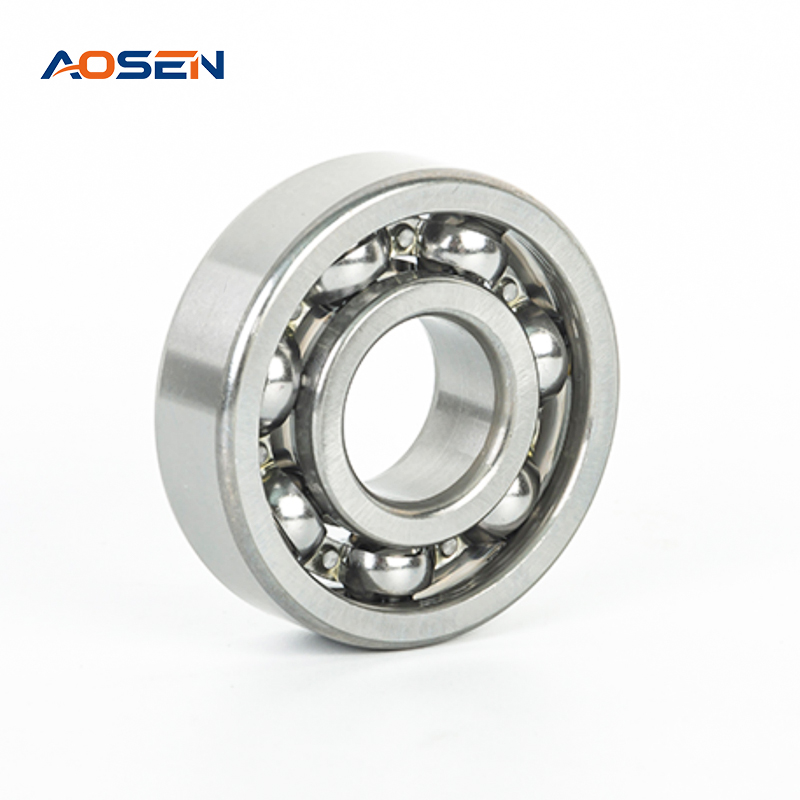
A deep groove ball bearing is the most widely used type of rolling-element bearing in the world. It consists of an inner ring, an outer ring, a set of steel balls, and a cage that maintains uniform ball spacing. The defining feature is its deep, continuous raceway grooves on both the inner and outer rings—grooves that are significantly deeper than those found in standard ball bearings. This geometry allows the bearing to handle both radial and axial (thrust) loads in either direction, making it a genuinely versatile single-component solution.
In practical terms, deep groove ball bearings are the default choice for any rotating shaft application. They are found in electric motors, gearboxes, bicycles, household appliances, machine tools, automotive alternators, and thousands of other systems. A single 6205-series bearing—one of the most common sizes—supports radial loads up to 14.8 kN and axial loads up to 6.55 kN in a package weighing only a few hundred grams.
Core Structure: What Each Component Does
Every deep groove ball bearing shares the same fundamental four-part architecture. Understanding each component explains why the bearing performs as it does.
Inner Ring
The inner ring fits tightly onto the rotating shaft. Its outer surface contains the deep raceway groove that guides the balls. It rotates with the shaft in most applications, though in some designs the outer ring rotates while the inner ring stays stationary.
Outer Ring
The outer ring sits inside the housing or bearing seat and is typically held stationary. Its inner surface carries a matching deep groove raceway. The combination of deep grooves on both rings is what distinguishes this bearing type and enables its axial load capacity.
Rolling Elements (Steel Balls)
Precision ground steel balls roll between the two raceways. The balls make point contact with the raceways, which minimizes friction and allows very high rotational speeds. Ball diameter and the number of balls determine the load capacity and speed rating of the bearing.
Cage (Retainer)
The cage keeps the balls evenly spaced around the circumference, preventing them from touching each other and causing friction. Cages are made from stamped steel, machined brass, or injection-molded polyamide (nylon). Polyamide cages are preferred for high-speed applications due to their lower weight and better vibration damping characteristics.
How Deep Groove Ball Bearings Work
When a shaft rotates, the inner ring rotates with it while the outer ring remains fixed. The steel balls roll along the raceway grooves, converting sliding friction into rolling friction—a fundamental shift that reduces energy loss by a factor of 10 to 100 times compared to plain sleeve bearings at equivalent loads.
The depth of the raceway grooves is the critical design feature. Because the groove radius is only slightly larger than the ball radius (typically a groove-to-ball radius ratio of 0.52–0.53), the balls are held securely within the groove even when axial forces push them sideways. This is why deep groove bearings can handle thrust loads that would cause shallower-groove bearings to skip or fail.
Lubrication—either grease or oil—forms a thin film between balls and raceways, preventing direct metal-to-metal contact. In pre-greased, sealed bearings, this film is maintained for the bearing's entire service life without any user intervention.
Types of Deep Groove Ball Bearings
The deep groove ball bearing family includes several variants, each optimized for specific operating conditions.
Open Bearings
Open bearings have no shields or seals on either side. They are suitable for clean, dry environments where external lubrication is applied and maintained regularly. Open designs allow higher speeds because there is no seal drag, and they are easier to regrease in service.
Shielded Bearings (ZZ / 2Z)
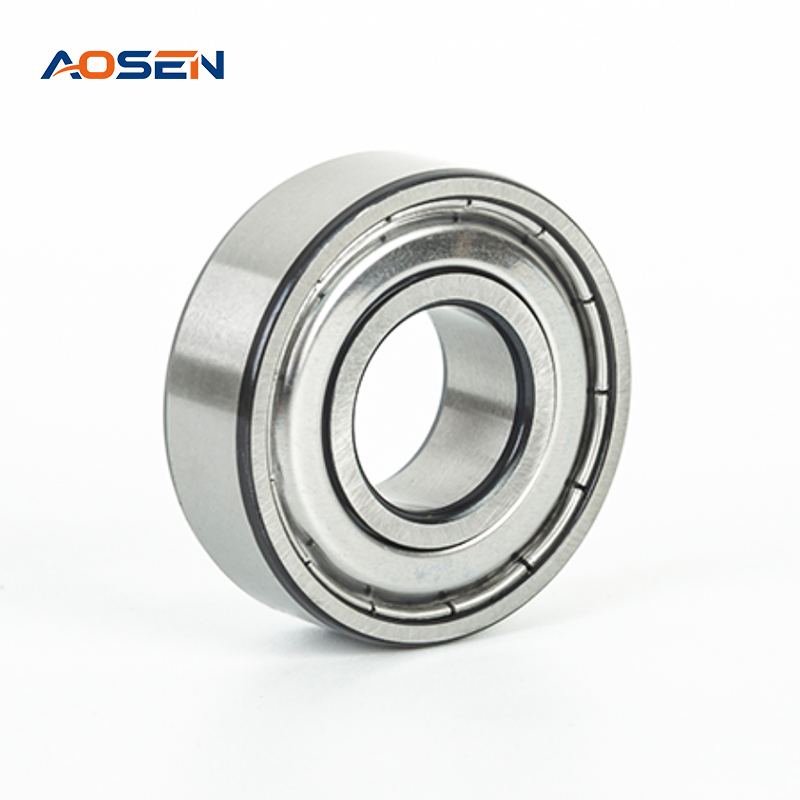
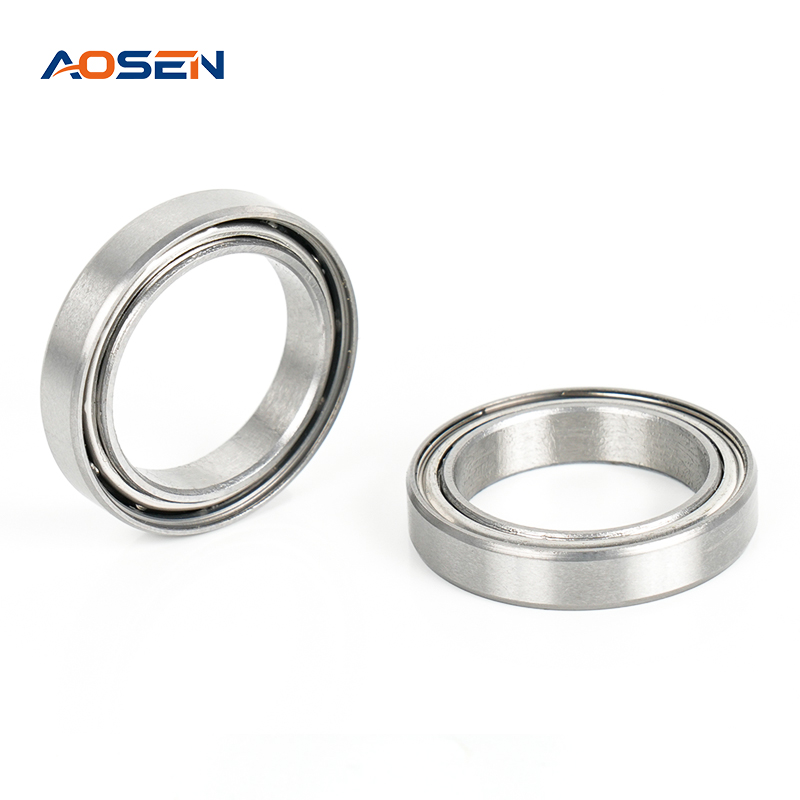
Metal shields (designated "Z" for one side, "ZZ" or "2Z" for both sides) are pressed into grooves in the outer ring. They stop large particles from entering the bearing interior but do not make contact with the inner ring, so they add virtually no friction. Shielded bearings come pre-greased and are suitable for moderately contaminated environments.
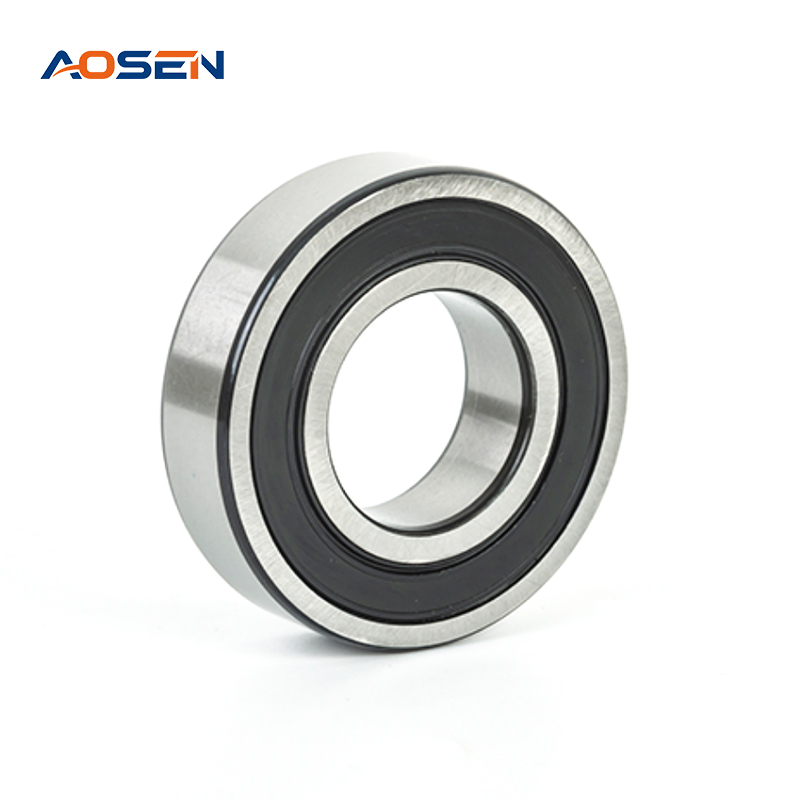
Sealed Bearings (RS / 2RS)
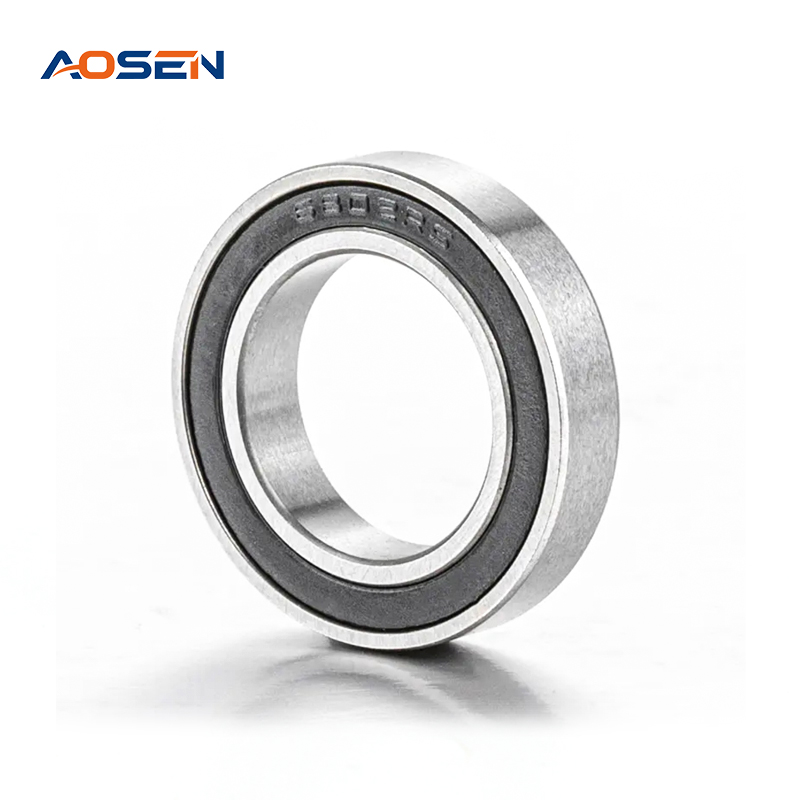
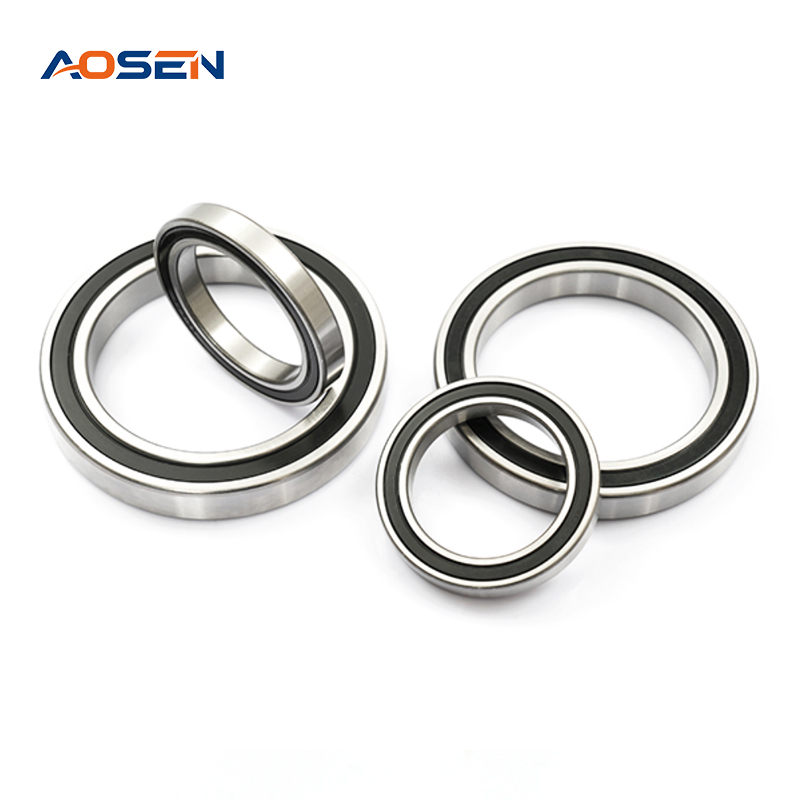
Rubber or PTFE seals (designated "RS" for one side, "2RS" for both sides) make light contact with the inner ring, providing superior protection against dust, water, and contaminants. This contact creates slightly more friction than shields, limiting maximum speed by about 30–50% compared to open equivalents. However, 2RS sealed bearings are the most popular configuration globally because they are maintenance-free for life in most applications.
Single-Row vs. Double-Row
Standard deep groove ball bearings have a single row of balls. Double-row deep groove ball bearings contain two parallel rows of balls within a single bearing unit, approximately doubling the radial load capacity without increasing the outer diameter significantly. They are used in applications requiring compact, high-load capacity such as gearboxes and heavy-duty electric motors.
Snap Ring Bearings
These have a circumferential groove on the outer ring that accepts a snap ring (circlip). The snap ring simplifies axial positioning in the housing, eliminating the need for machined shoulders or other retention features. Commonly used in electric motors and pumps.
Deep Groove Ball Bearings vs. Other Bearing Types
Choosing the right bearing type requires understanding the trade-offs between deep groove ball bearings and their common alternatives.
Comparison of deep groove ball bearings against angular contact, cylindrical roller, and tapered roller bearings
| Factor |
Deep Groove Ball |
Angular Contact Ball |
Cylindrical Roller |
Tapered Roller |
| Radial Load Capacity |
Good |
Good |
Very High |
Very High |
| Axial Load Capacity |
Moderate (both directions) |
High (one direction) |
Very Low |
High (one direction) |
| Maximum Speed |
Very High |
High |
High |
Moderate |
| Friction / Heat |
Very Low |
Low |
Low |
Moderate |
| Noise Level |
Very Low |
Low |
Low–Moderate |
Moderate |
| Cost |
Low |
Moderate |
Moderate |
Moderate–High |
| Misalignment Tolerance |
Low (2–10 arcmin) |
Very Low |
Very Low |
Low |
The takeaway is clear: deep groove ball bearings offer the best combination of speed capability, low friction, bidirectional axial load handling, and low cost—making them the rational default unless load levels demand roller bearings or high thrust demands require angular contact designs.
Understanding the Bearing Designation System
Deep groove ball bearings follow a standardized ISO designation system. Knowing how to read a bearing number allows you to identify any bearing's dimensions and configuration instantly.
Take the example bearing 6205-2RS1/C3:
- 6 — Bearing type: deep groove ball bearing
- 2 — Dimension series (width and diameter series combined): indicates a medium-width, medium-diameter series
- 05 — Bore code: multiply by 5 to get bore diameter in mm. 05 × 5 = 25 mm bore
- 2RS1 — Suffix: two rubber seals (RS) on both sides, variant 1
- C3 — Internal clearance class: greater than normal clearance, suitable for higher operating temperatures or press-fit applications
For bore sizes 04 and above, the bore diameter in mm = bore code × 5. Bore codes 00, 01, 02, and 03 correspond to 10 mm, 12 mm, 15 mm, and 17 mm respectively as special cases.
Key Performance Specifications to Evaluate
Selecting the correct bearing requires evaluating these core specifications against your application's demands.
Key deep groove ball bearing specifications with definitions and representative values for the 6205 series
| Specification |
Definition |
6205 Example Value |
| Dynamic Load Rating (C) |
Load at which 90% of bearings reach 1,000,000 revolutions |
14.8 kN |
| Static Load Rating (C₀) |
Maximum load without permanent deformation |
7.8 kN |
| Limiting Speed (Grease) |
Maximum continuous speed with grease lubrication |
13,000 RPM |
| Limiting Speed (Oil) |
Maximum continuous speed with oil lubrication |
17,000 RPM |
| Basic L10 Life |
Operating hours at which 90% survive at given load/speed |
Calculated per application |
| Internal Clearance |
Total movement of inner ring relative to outer ring |
CN (normal), C3, C4 |
| Operating Temperature |
Typical range with standard grease |
−20°C to +120°C |
Real-World Applications Across Industries
Deep groove ball bearings appear in virtually every industry that involves rotating machinery. Their breadth of application is unmatched by any other bearing type.
Electric Motors
The vast majority of electric motors—from fractional-horsepower appliance motors to large industrial AC induction motors—use deep groove ball bearings at both the drive end and non-drive end. A standard IEC 100-frame motor typically uses 6208 bearings (40 mm bore, 80 mm OD) rated for continuous operation at 3,000 RPM for tens of thousands of hours.
Automotive Systems
Alternators, starter motors, power steering pumps, air conditioning compressors, and electric window motors all use deep groove ball bearings. Automotive-grade bearings are designed for temperatures up to 150°C and service lives exceeding 200,000 km, with special grease formulations to handle the associated thermal cycling.
Household Appliances
Washing machine drums, vacuum cleaner motors, fans, and refrigerator compressors rely on sealed 2RS deep groove ball bearings. The maintenance-free sealed design is essential here since consumer products cannot be regularly relubricated by users.
Bicycles and Power Sports
Bicycle bottom brackets, wheel hubs, and headsets use miniature or standard deep groove ball bearings. E-bike hub motors typically use 6001 or 6002 series bearings (12–15 mm bore) that must survive shock loads, water exposure, and continuous high-speed operation.
Industrial Machinery and Robotics
Conveyor rollers, pumps, fans, textile machinery, and robot joint actuators all depend on deep groove ball bearings. In robotics, precision-ground bearings with ABEC-5 or ABEC-7 tolerance classes provide the dimensional accuracy needed for repeatable positioning.
Lubrication: Grease vs. Oil and Best Practices
Lubrication accounts for the majority of deep groove ball bearing failures when incorrectly managed. Getting it right is the single most impactful maintenance decision.
Grease Lubrication
Grease is the standard choice for most applications. It stays in place, requires no circulation system, and provides adequate lubrication for speeds up to the bearing's grease limiting speed. The optimal fill level is 30–50% of the bearing's free internal volume—overfilling causes heat buildup and accelerated grease degradation. Lithium-based NLGI Grade 2 grease suits most general applications from −20°C to +120°C.
Oil Lubrication
Oil lubrication is used when speeds exceed the grease limiting speed, when the operating temperature is very high, or when the bearing is part of a gearbox with an existing oil bath. Oil provides better cooling and allows higher speeds—typically 15–30% higher than the grease speed limit—but requires sealed housings or circulation systems to retain and manage the lubricant.
Regreasing Intervals
For open bearings in accessible housings, regreasing intervals depend on bearing size, speed, and temperature. As a general guideline, a 6206 bearing running at 1,500 RPM at 70°C should be regreased approximately every 5,000–8,000 operating hours. Higher temperatures dramatically shorten intervals: every 15°C rise above 70°C approximately halves the regreasing interval.
Installation Best Practices to Maximize Service Life
Improper installation is responsible for a significant portion of premature bearing failures—industry estimates suggest over 50% of bearing failures trace back to installation errors, contamination, or incorrect fits.
- Always apply force to the ring being press-fitted. When pressing a bearing onto a shaft, apply force only to the inner ring. When pressing into a housing, apply force only to the outer ring. Forcing through the balls damages the raceways immediately.
- Use proper fitting tools. A bearing fitting tool set or an appropriately sized sleeve ensures uniform force distribution. Hammering directly on the bearing ring causes brinelling (surface indentation) and immediate noise and vibration issues.
- Verify shaft and housing tolerances. The correct interference fit is essential. For a rotating inner ring, shaft tolerance is typically j5 to k5. For a stationary outer ring, housing tolerance is typically H7. Consult ISO fit tables for your specific load and speed conditions.
- Use thermal mounting for larger bearings. For bearings with bore diameters above 80 mm, induction heating to 80–100°C expands the bearing sufficiently for slip-fit installation onto the shaft, avoiding the need for high press forces that could damage the raceway.
- Keep the workspace clean. Even small particles of grit or metal contamination between ball and raceway cause rapid wear. Work on a clean bench, and do not remove bearing packaging until the moment of installation.
- Check shaft and housing geometry. Out-of-round shafts or housings cause the bearing to assume a non-circular shape under operation, creating stress concentrations and early fatigue failure. Maximum recommended roundness deviation is typically one-quarter of the applicable bearing tolerance.
Common Failure Modes and How to Diagnose Them
Recognizing bearing failure modes early allows planned replacement before secondary damage occurs to surrounding components.
- Fatigue spalling: Flaking of the raceway surface after the bearing reaches its calculated service life. Characterized by increasing vibration and noise. Normal failure mode when bearing has been properly selected and maintained—replace with the same or upgraded specification.
- Brinelling (false or true): Dents or indentations in the raceway at ball-spacing intervals. True brinelling results from static overload. False brinelling (fretting) occurs from vibration while the bearing is stationary, common in stored equipment or transported machinery. Both cause rough running and noise from the first moment of operation.
- Contamination wear: Abrasive particles in the lubricant cause rapid, diffuse surface wear on raceways and balls. The bearing becomes noisy and develops excessive clearance. Prevention: use sealed bearings or improve housing sealing; implement oil filtration in circulating oil systems.
- Corrosion: Rust pitting on raceways from moisture ingress or aggressive chemicals. Pitted surfaces initiate fatigue cracks and cause noisy, rough operation. Use bearings with stainless steel rings (designated 440C stainless) or apply corrosion-resistant coatings for wet environments.
- Electrical erosion (fluting): Stray electrical currents passing through the bearing create regular patterns of pitting across the raceway, called fluting. Common in variable-frequency drive (VFD) motor applications. Solution: use electrically insulated bearings (hybrid ceramic ball bearings or insulated ring coatings).
- Overheating: Discoloration of rings from blue to black indicates temperatures above 200°C. Causes include over-greasing, insufficient clearance after press fit, excessive speed, or loss of lubrication. Overheated bearings lose hardness and fail rapidly; the root cause must be identified before replacement.

 Español

 +86-15990593443
 No. 558 Huancheng West Road, Zhouxiang Town, Cixi City, Ningbo Province, Zhejiang Province