
- Home
- Products
- Deep Groove Ball Bearings
- Stainless Steel Deep Groove Ball Bearings
- SS 6000 Series Stainless Steel Deep Groove Ball Bearings
- SS 6200 Series Stainless Steel Deep Groove Ball Bearings
- SS 6300 Series Stainless Steel Deep Groove Ball Bearings
- SS 6700 Series Stainless Steel Deep Groove Ball Bearings
- SS 6800 Series Stainless Steel Deep Groove Ball Bearings
- SS 6900 Series Stainless Steel Deep Groove Ball Bearings
- Angular Contact Ball Bearings
- Flange Bearings
- Bicycle Headset Bearings
- About Us
- Application
- News
- Contact Us

 Español
Menu
- Home
- Products
- Deep Groove Ball Bearings
- Stainless Steel Deep Groove Ball Bearings
- SS 6000 Series Stainless Steel Deep Groove Ball Bearings
- SS 6200 Series Stainless Steel Deep Groove Ball Bearings
- SS 6300 Series Stainless Steel Deep Groove Ball Bearings
- SS 6700 Series Stainless Steel Deep Groove Ball Bearings
- SS 6800 Series Stainless Steel Deep Groove Ball Bearings
- SS 6900 Series Stainless Steel Deep Groove Ball Bearings
- Angular Contact Ball Bearings
- Flange Bearings
- Bicycle Headset Bearings
- About Us
- Application
- News
- Contact Us
Industry News
Home / News / Industry News / What Are Angular Contact Ball Bearings and How Do They Work, Types, and Applications?
What Are Angular Contact Ball Bearings and How Do They Work, Types, and Applications?
Working Principle of Angular Contact Ball Bearings
Understanding the working principle of angular contact ball bearings begins with the contact angle, because it is this geometric parameter that fundamentally controls all other performance characteristics of the bearing. In a standard deep groove ball bearing, the contact between the ball and both raceways is approximately radial, meaning the load transfer line between the inner raceway contact point, the ball center, and the outer raceway contact point is nearly perpendicular to the bearing axis. The raceway geometry in such a bearing resists radial loads effectively but provides limited resistance to axial loads because the ball to raceway contact geometry does not present a large projected area in the axial direction to resist axial force.
The Significance of the Contact Angle
In angular contact bearing design, the inner and outer raceway grooves are positioned asymmetrically along the bearing axis, creating an offset between the inner and outer groove center planes. When a ball sits in these offset grooves, the line connecting its inner and outer raceway contact points is inclined at the contact angle relative to the radial plane. This inclination means that the load capacity of the bearing is distributed between radial and axial directions according to the contact angle: as the contact angle increases, the proportion of the bearing's load capacity available in the axial direction increases while the radial load capacity decreases proportionally.
Specifically, for a bearing with contact angle alpha, the axial load capacity is proportional to sin(alpha) and the radial load capacity is proportional to cos(alpha). At a contact angle of 15 degrees, sin(15°) equals 0.259 and cos(15°) equals 0.966, indicating a bearing primarily optimized for radial loads with moderate axial capacity. At a contact angle of 40 degrees, sin(40°) equals 0.643 and cos(40°) equals 0.766, indicating a substantially higher proportion of load capacity in the axial direction. The 40 degree contact angle is the standard selection for applications where axial loads are the primary design driver, such as machine tool spindles operating under heavy cutting forces in one direction, or screw type actuator thrust bearings.
Internal Raceway Displacement Along the Bearing Axis
The offset between the inner and outer groove center planes in an angular contact ball bearing means that the line of action of the resultant bearing force passes through the bearing at a point on the bearing axis that is displaced from the geometric center of the bearing. This displaced load application point is called the pressure center or effective load center of the bearing. For single row angular contact ball bearings, the pressure center is located outside the bearing width on the side from which the axial load acts. This displacement of the pressure center has significant consequences for bearing arrangement design, particularly in paired bearing configurations, because the separation between the pressure centers of two bearings in a system determines the effective bearing span and therefore the system stiffness and the induced moment reactions on the shaft.
Combined Radial and Axial Load Handling
Angular contact ball bearings handle combined loads through the inclination of the contact load line between each ball and its raceways. When a combined radial and axial load is applied to the bearing, the resultant force at each loaded ball to raceway contact point has both radial and axial components that are resolved through the inclined contact geometry. The bearing's ability to handle combined loads is quantified by the equivalent dynamic load, which is a calculated single axis load that produces the same bearing fatigue life as the actual combined load. The equivalent dynamic load P is calculated as P = X × Fr + Y × Fa, where Fr is the radial load, Fa is the axial load, and X and Y are radial and axial load factors that depend on the contact angle and the ratio of axial to radial load. For a contact angle of 40 degrees under pure axial loading conditions, the Y factor approaches 0.6, meaning the axial load capacity is approximately 67 percent of the basic dynamic load rating C, significantly higher than the Y factor of approximately 1.0 for a 15 degree contact angle bearing.
Types of Angular Contact Ball Bearings
Angular contact ball bearings are produced in several structural configurations, each optimized for different combinations of load direction, space constraints, and mounting requirements. Understanding the characteristics of each type is essential for selecting the correct bearing for a specific application.
Single Row Angular Contact Ball Bearings
The single row angular contact ball bearing is the fundamental and most widely used configuration in the angular contact bearing family. It consists of a single row of balls running in offset inner and outer raceway grooves, with a cage to maintain ball spacing and the characteristic contact angle that defines its load capacity distribution. The key characteristics of single row angular contact ball bearings are:
- High speed capability: The low mass and well defined contact geometry of the single row design, combined with precision manufacturing tolerances, allow operation at very high rotational speeds. The speed limit of a single row angular contact ball bearing is expressed as the product of the bore diameter in millimeters and the speed in rpm (the DN value), with values up to 3 million DN achievable in precision grade oil lubricated designs.
- Unidirectional axial load capacity: A single row angular contact ball bearing can carry axial loads in only one direction: the direction that loads the balls against the higher shoulder of the outer raceway (or inner raceway, depending on the bearing orientation). If the application requires axial load support in both directions, two single row bearings must be used in a paired arrangement, or an alternative bearing type must be selected.
- Precision and stiffness: Single row angular contact ball bearings are manufactured in precision grades (ABEC 5, 7, and 9 or ISO P5, P4, and P2) that provide the dimensional accuracy and running accuracy required for precision spindle applications. When properly preloaded in a paired arrangement, they provide exceptional stiffness and positioning accuracy.
Because the single row angular contact ball bearing can only support axial loads in one direction, it must be paired with another bearing in virtually all practical applications. Three standard pairing arrangements are used:
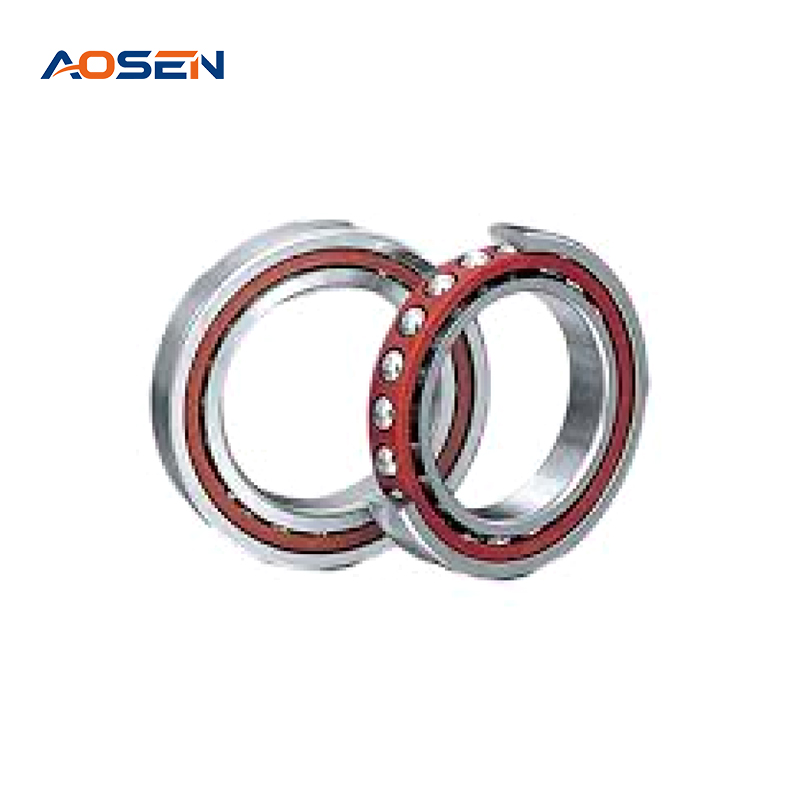
- Back to back arrangement (DB): The two bearings are mounted with their high shoulders facing away from each other (back to back). This arrangement results in a wide effective span between the pressure centers, providing high tilting moment resistance and making the arrangement suitable for applications where overhanging loads create significant bending moments on the shaft.
- Face to face arrangement (DF): The two bearings are mounted with their high shoulders facing each other (face to face). This arrangement results in a narrow effective span and is more tolerant of shaft misalignment than the DB arrangement, making it suitable for shafts that may deflect under load or where mounting accuracy is limited.
- Tandem arrangement (DT): Both bearings are mounted with the same orientation, so their axial load capacities add together in one direction. This arrangement is used where a single bearing is insufficient to carry the required axial load in one direction, and a second bearing is added in tandem to double the axial load capacity. The tandem arrangement cannot carry axial loads in the opposite direction and must be combined with another bearing to provide axial constraint in both directions.
Double Row Angular Contact Ball Bearings
The double row angular contact ball bearing incorporates two rows of balls within a single bearing envelope, effectively combining two single row bearings in a back to back or face to face arrangement within the same outer ring and bore. This design provides significant advantages in applications where space constraints prevent the use of two separate single row bearings, or where the simplicity of a single bearing unit is desirable for ease of installation and reduced assembly complexity. The double row angular contact ball bearing inherently supports axial loads in both directions, because its two rows are oriented with opposing contact angles. In terms of space efficiency, a double row angular contact ball bearing typically saves 30 to 40 percent of the axial space required for two separate single row bearings of equivalent capacity, making it the preferred selection for compact spindle designs and instrument bearings where envelope dimensions are critical.
Four Point Contact Angular Contact Ball Bearings
Four point contact angular contact ball bearings use a unique raceway design in which each ball contacts both the inner and outer raceways at two points simultaneously, creating four contact points per ball (two on the inner raceway and two on the outer raceway). This design is achieved by using a Gothic arch raceway profile with a radius of curvature slightly smaller than the ball radius, creating two separate contact points on each raceway surface rather than the single central contact of a standard circular arc groove. The four point contact design allows a single row bearing to carry axial loads in both directions simultaneously, which standard single row angular contact ball bearings cannot achieve, while maintaining a very compact axial envelope. The axial load capacity of a four point contact bearing per unit of axial width is significantly higher than that of a standard single row angular contact ball bearing of the same bore and outer diameter, making this design the preferred choice for slewing rings, turntable bearings, and other applications where high axial loads in both directions must be accommodated in a thin cross section. The limitation of the four point contact design is that the simultaneous two point contact on each raceway generates higher internal stresses at each contact point and produces more heat at high rotational speeds, limiting the maximum speed rating compared to standard single row designs.
Angular Contact Ball Bearings Product Series: 7000, 7200, and 7300
The dimensional series designation system for angular contact ball bearings follows the ISO bearing designation framework in which the first digit of the bearing number indicates the dimensional series (the relationship between bore diameter and outer diameter) and the contact angle is specified separately. The three main standard series for angular contact ball bearings in general industrial and precision applications are the 7000, 7200, and 7300 series, which represent light, medium, and heavy dimensional series respectively.
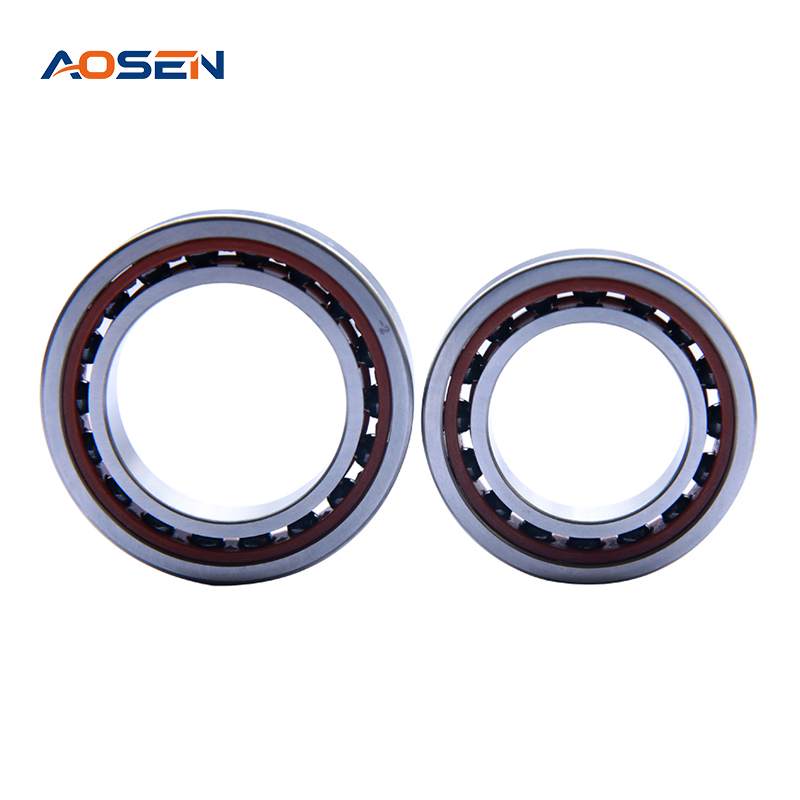
7000 Series Angular Contact Ball Bearings are high precision, high speed single row bearings designed with a small contact angle, typically around 15 degrees, making them ideal for applications where speed and accuracy are more critical than load capacity. Their optimized internal geometry reduces friction and heat generation, allowing stable performance at very high rotational speeds while maintaining excellent rigidity and dimensional stability. Thanks to precision manufacturing and high quality materials, these bearings operate with low vibration and noise, making them particularly suitable for CNC machine tool spindles, precision motors, medical instruments, and high speed automation systems where smooth operation and accuracy are essential.
7200 Series Angular Contact Ball Bearings are engineered with a larger contact angle, typically between 20 and 30 degrees, providing a balanced performance between axial and radial load capacity. This design enables the bearings to support significant axial loads in both directions while still maintaining stability under high speed conditions. With strong rigidity, controlled thermal expansion, and precise tolerance levels, the 7200 series performs reliably in demanding environments that require both accuracy and durability. These bearings are widely used in high precision machine tool spindles, industrial motors, automated production lines, and robotic systems where combined loads and consistent performance are required.
7300 Series Angular Contact Ball Bearings are designed for heavy duty applications, featuring a large contact angle of approximately 30 degrees that allows them to withstand substantial axial loads and operate reliably under high load conditions. Their robust construction, combined with high quality steel and advanced manufacturing processes, ensures excellent rigidity, fatigue resistance, and long service life even in harsh operating environments. These bearings maintain stable performance under high speeds and temperatures, making them ideal for large machine tool systems, heavy industrial equipment, aerospace applications, and precision machinery that demand both high load capacity and long term operational stability.
| Series | Dimensional Series | Typical Contact Angle | Speed Capability | Load Characteristic | Primary Applications |
|---|---|---|---|---|---|
| 7000 Series | Extra light (00) | 15 degrees | Very high (up to 3 million DN) | High radial, moderate axial | CNC spindles, precision motors, medical instruments |
| 7200 Series | Light (02) | 20 to 30 degrees | High (up to 2 million DN) | Balanced combined load | Machine tool spindles, industrial motors, robotics |
| 7300 Series | Medium (03) | 30 degrees | Medium (up to 1.5 million DN) | High axial load capacity | Heavy machine tools, aerospace, industrial equipment |
Technical Specifications of Angular Contact Ball Bearings
Angular contact ball bearings are manufactured to carefully controlled technical specifications that govern their dimensional accuracy, running accuracy, surface finish, and material properties. Understanding these specifications is essential for selecting bearings that will meet the precision and performance requirements of demanding applications.
Precision Classes: ABEC and ISO Standards
Angular contact ball bearings for precision applications are manufactured to precision tolerance classes defined by ABEC (Annular Bearing Engineers Committee) in North America and by ISO (International Organization for Standardization) globally. The precision class defines tolerances on bore diameter, outer diameter, width, radial runout of the inner and outer rings, and axial runout of the bearing faces. The standard precision classes in ascending order of precision are:
- ABEC 1 (ISO Normal or P0): Standard precision for general industrial applications, adequate for most motors, pumps, and general machinery where positional accuracy is not a critical requirement.
- ABEC 3 (ISO P6): Improved precision class with tighter tolerances on dimensional accuracy and running accuracy, used in applications requiring better than standard dimensional control and reduced radial runout.
- ABEC 5 (ISO P5): Precision class for machine tool spindles, precision motors, and other applications where rotational accuracy and dimensional repeatability are critical. ABEC 5 bearings have radial runout tolerances of the order of 5 micrometers on the inner ring.
- ABEC 7 (ISO P4): High precision class for demanding machine tool spindle applications and precision instruments. Radial runout tolerances are reduced to approximately 2.5 micrometers, and tolerances on bore and outer diameter are correspondingly tightened. ABEC 7 and ABEC 9 angular contact ball bearings are the standard specification for high precision grinding machine and coordinate measuring machine spindles where sub micron positional accuracy is required.
- ABEC 9 (ISO P2): Ultra precision class for the most demanding gyroscope, precision instrument, and ultra high speed spindle applications, with radial runout tolerances of the order of 1 micrometer.
Cage Materials: Steel, Brass, and Polyamide
The cage in an angular contact ball bearing maintains the circumferential spacing of the balls, guides the balls during rotation, and distributes lubricant within the bearing. Cage material selection has a significant effect on the bearing's speed capability, operating temperature range, and compatibility with different lubrication systems:
- Pressed steel cage: The most common cage material for standard and medium precision angular contact ball bearings. Steel cages are strong, dimensionally stable, and compatible with both grease and oil lubrication over a wide temperature range from approximately -40 degrees Celsius to +150 degrees Celsius. Their higher mass compared to polyamide cages limits their use in the highest speed applications.
- Brass (machined) cage: Machined brass cages are used in precision grade angular contact ball bearings for machine tool spindles and high temperature applications. Brass is dimensionally stable, has good thermal conductivity, and is compatible with oil lubrication at temperatures up to 200 degrees Celsius. The mass of brass cages is higher than polyamide but lower than steel cages of equivalent section.
- Polyamide (molded) cage: Injection molded polyamide (nylon) cages are the preferred choice for very high speed applications because their low density (approximately one seventh that of steel) significantly reduces centrifugal loading on the cage and the ball to cage contact forces at high rotational speeds. Polyamide cages are compatible with grease lubrication and non aggressive oil lubrication up to approximately 120 degrees Celsius, limiting their use in high temperature applications.
Lubrication Methods: Grease vs Oil Systems
The lubrication system of an angular contact ball bearing has a profound effect on its operating temperature, speed limit, and service life. Two primary lubrication methods are used in practice:
- Grease lubrication: Grease lubricated angular contact ball bearings are simpler in their supporting system requirements, since they do not need an external oil supply, pump, or recirculation system. Precision grade high speed grease with a low base oil viscosity (15 to 50 cSt at 40 degrees Celsius) and a suitable thickener (typically lithium complex or polyurea) is used. Grease lubrication is suitable for speed parameters (DN values) up to approximately 1.5 million for angular contact ball bearings, beyond which the heat generation in the grease exceeds its ability to dissipate heat and the grease degrades rapidly. Grease lubricated bearings are pre filled at the factory and require no user maintenance during normal service life in typical applications, typically achieving service lives of several thousand hours before re greasing is required.
- Oil lubrication (circulating oil and air oil mist): For very high speed applications such as grinding spindles and precision machining centers operating above the grease speed limit, oil lubrication is required. Two oil lubrication methods are used: oil mist lubrication, in which a fine mist of oil droplets is carried into the bearing by a stream of air; and oil air lubrication (also called minimum quantity lubrication), in which precisely metered small volumes of oil are delivered to the bearing at defined time intervals by a compressed air carrier. Air oil lubrication systems can sustain DN values of 2 to 3 million in angular contact ball bearings, more than double the grease lubrication limit, by providing a continuous supply of fresh oil that removes heat from the bearing contact zones and prevents thermal breakdown of the lubricant film.
Applications of Angular Contact Ball Bearings
The combination of high speed capability, precision, and combined load bearing capacity makes angular contact ball bearings the standard choice across a wide spectrum of demanding rotating machinery applications. The following sections describe the principal application areas and the specific bearing requirements each presents.
Machine Tool Spindles
Machine tool spindles represent the most technically demanding and most commercially important application sector for precision angular contact ball bearings. A spindle must simultaneously achieve very high rotational accuracy (to produce precision workpieces), operate at high rotational speeds (to achieve optimum cutting speeds with modern carbide and ceramic cutting tools), resist the combined radial and axial cutting forces generated during machining, maintain dimensional stability over a wide operating temperature range, and achieve a service life of tens of thousands of operating hours. Angular contact ball bearings meet all of these requirements when correctly specified, and are used in virtually every type of machine tool spindle: milling, turning, grinding, drilling, and boring.
In a typical machining center spindle, two or three angular contact ball bearings in a DB or tandem face arrangement at the front, with a single floating bearing at the rear, provide the high rigidity and high speed support required. Front bearings are preloaded to maximize stiffness; the rear bearing floats axially to accommodate thermal expansion.
Pumps and Compressors
Centrifugal pumps and compressors use angular contact ball bearings to support their impeller shafts against combined radial and axial loads from rotor imbalance, fluid reaction forces, and pressure differences across the impeller. In pumps handling corrosive fluids, ceramic hybrid angular contact ball bearings with silicon nitride balls provide the corrosion resistance required for reliable service in aggressive fluid environments.
Automotive Systems
Angular contact ball bearings serve critical functions in multiple automotive subsystems. In automotive wheel hub units (particularly front wheel drive hubs), angular contact ball bearings in double row configuration support the combined radial loads from vehicle weight and the axial loads from cornering forces that can be several times the vehicle's static weight at the loaded wheel. Automotive alternator and electric power steering motor bearings use precision angular contact ball bearings to achieve the combination of low noise, long service life, and the ability to resist the axial load components generated by helical gear tooth forces and belt tension loads.
High Speed Motors and Turbines
High speed electric motors, gas turbines, and turbochargers operate at speeds where only angular contact ball bearings of the highest precision and with optimized lubrication provide reliable service. Turbocharger bearings operate with shaft speeds up to 300,000 rpm, elevated temperatures from the exhaust gas side, and significant radial and axial load variation. Specialized angular contact ball bearings with silicon nitride ceramic balls have become standard in modern turbocharger designs, as the lower mass and higher hardness of ceramic balls reduce centrifugal loading and contact stresses, extending service life significantly compared to all steel designs.
Selection and Maintenance of Angular Contact Ball Bearings
Correct selection of angular contact ball bearings requires a systematic engineering analysis of the application's load conditions, speed requirements, space constraints, precision requirements, and environmental conditions. Incorrect selection is the most common cause of premature bearing failure in service, and the following framework covers the essential steps in a sound selection process.
Equivalent Dynamic Load Calculation
The fundamental starting point for angular contact ball bearing selection is the calculation of the equivalent dynamic load, which converts the actual combined radial and axial load acting on the bearing into a single equivalent radial load that can be compared with the bearing's basic dynamic load rating. The formula is P = X × Fr + Y × Fa, where X is the radial load factor and Y is the axial load factor from the bearing manufacturer's catalog for the specific contact angle and load ratio. Once the equivalent dynamic load P is calculated, the basic rating life L10 (in millions of revolutions) can be determined as L10 = (C/P)^3, where C is the basic dynamic load rating. For a required service life in hours, the required load rating can be back calculated to verify that the selected bearing provides adequate fatigue life at the operating speed and load.
Preloading Methods for Rigidity
Preloading is the application of an internal axial force to an angular contact ball bearing pair to eliminate internal clearance and create a compressive preload on the rolling elements, increasing the contact stiffness of the bearing system. Preloading is essential in precision spindle applications to maximize system stiffness and minimize shaft deflection under cutting loads. Two preloading methods are used:
- Positional preload (rigid preload): The preload is set by controlling the axial displacement between the inner and outer rings of the bearing pair through precise spacer lengths. Positional preload provides very high and well defined stiffness but can be affected by differential thermal expansion of the shaft and housing, which can increase the preload unpredictably at elevated temperatures. Positional preload is used in high precision grinding spindles and other applications where maximum stiffness is essential.
- Spring preload (constant force preload): A coil spring or disc spring is used to apply a constant axial force to the bearing pair, maintaining a defined preload level regardless of temperature or shaft deflection. Spring preload is more tolerant of dimensional changes during operation and is preferred in applications where thermal stability and consistent preload over the operating temperature range are more important than maximum rigidity. Spring preload levels for angular contact ball bearings in machine tool spindles are typically in the range of 50 to 500 Newtons for precision spindle bearings in the 20 to 80 millimeter bore range, with the specific value determined by the trade off between rigidity and heat generation that is acceptable for the application.
Installation Best Practices
Correct installation is as important as correct selection in achieving the expected bearing service life. The key installation practices for angular contact ball bearings are:
- Handle precision bearings with clean, dry tools and work in a clean environment. Even small particles of contamination introduced during installation can cause premature wear and fatigue on the precisely finished raceway surfaces of precision grade bearings.
- Never apply force through the rolling elements during installation. Mounting force must always be applied to the bearing ring that is being press fitted. For an interference fit on the shaft, apply mounting force to the inner ring. For an interference fit in the housing, apply force to the outer ring. Applying force through the rolling elements creates brinelling damage on the raceways that degrades running accuracy and increases vibration.
- Verify the correct orientation of paired bearings. Single row angular contact ball bearings are marked with an identification mark on the outer ring to indicate the direction of the contact angle. Paired bearings must be oriented correctly (back to back, face to face, or tandem as specified) for the arrangement to function correctly. Incorrectly oriented pairs will be severely overloaded on one side of the arrangement and unloaded on the other.
- Use induction heating for installing larger bearings with interference fits. For bearings above approximately 60 millimeter bore diameter, induction heating to expand the inner ring to approximately 80 to 100 degrees Celsius above ambient temperature is the standard method for mounting onto a shaft with an interference fit, avoiding the mechanical damage risk of pressing cold rings onto shafts.
Vibration and Temperature Monitoring
Condition monitoring of angular contact ball bearings in service provides early warning of developing faults before they progress to failure, allowing planned maintenance intervals rather than emergency shutdowns. Two primary monitoring parameters are used:
- Vibration monitoring: Accelerometers mounted on the bearing housing measure vibration spectra that change characteristically as bearing faults develop. The characteristic defect frequencies for angular contact ball bearings (ball pass frequency outer ring, ball pass frequency inner ring, ball spin frequency, and cage frequency) can be calculated from the bearing geometry and rotational speed, and trending of these frequency components in the vibration spectrum provides early detection of raceway surface fatigue, rolling element damage, and cage wear before they produce a catastrophic failure event.
- Temperature monitoring: Elevated bearing operating temperature is a reliable indicator of lubrication deterioration, excessive preload, or developing mechanical damage. The normal operating temperature of a well lubricated angular contact ball bearing in a machine tool spindle is typically 10 to 30 degrees Celsius above ambient, and a sustained temperature increase of more than 10 degrees Celsius above the established baseline should trigger investigation of the cause before the bearing is allowed to continue in service.
FAQ About Angular Contact Ball Bearings
What Is the Difference Between Angular Contact and Deep Groove Ball Bearings?
The fundamental difference between angular contact ball bearings and deep groove ball bearings lies in the raceway geometry and therefore in the direction and magnitude of loads each type can carry. Deep groove ball bearings have symmetrical, relatively deep raceways in which the ball contacts the inner and outer raceways nearly radially, giving good radial load capacity and the ability to carry moderate bidirectional axial loads from the self centering geometry of the deep groove. Angular contact ball bearings have asymmetrical, shallower raceways offset along the bearing axis to create the contact angle, giving higher axial load capacity in the direction of the contact angle but limiting axial load capacity in the opposite direction. Angular contact ball bearings are also capable of higher precision grades and are designed for preloaded paired arrangements that deep groove ball bearings generally are not, making angular contact designs the choice for applications requiring maximum system stiffness and positional accuracy.
What Is the Best Contact Angle for High Speed Applications?
For applications where maximum rotational speed is the primary requirement, the smallest available contact angle provides the best performance. A 15 degree contact angle, as used in the 7000 series, minimizes the ball gyroscopic forces that resist ball spinning and generate heat at high speeds. Smaller contact angles also result in a more nearly radial contact load direction, which minimizes the differential sliding between the ball and the raceway at high rotational speeds. At very high DN values, even the conventional 15 degree design is supplanted by specialized designs with ceramic balls and optimized cage geometry. If significant axial loads must also be carried at high speeds, a 25 degree contact angle is the best compromise between axial capacity and speed performance. Contact angles of 40 degrees should only be used in high speed applications if the axial load requirement absolutely demands it and the resulting higher operating temperature is acceptable.
Can Angular Contact Ball Bearings Handle Bidirectional Axial Loads?
A single row angular contact ball bearing can only support axial loads in one direction: the direction that loads the balls against the high shoulder of the raceway. It cannot resist axial loads in the opposite direction. To support bidirectional axial loads, the designer must use one of three alternatives: a matched pair of single row angular contact ball bearings arranged back to back (DB) or face to face (DF), a double row angular contact ball bearing that combines two opposing rows in a single unit, or a four point contact angular contact ball bearing that uses the Gothic arch raceway profile to achieve bidirectional axial load support in a single row configuration. Each of these alternatives has different characteristics in terms of stiffness, speed capability, and space requirement, and the selection between them should be based on the specific load, speed, and dimensional requirements of the application.
How to Select the Right Angular Contact Ball Bearings?
The selection of angular contact ball bearings for a specific application follows a structured process that begins with defining the application requirements and progresses through a series of decisions to arrive at the correct bearing specification. The key selection steps are as follows:
Define the load conditions: Determine the magnitude and direction of the radial loads, axial loads, and moment loads, including any dynamic load amplification from shock, vibration, or eccentric loading, over the full range of operating conditions.
Select the contact angle: Choose the contact angle based on the ratio of axial to radial load. A load ratio Fa/Fr below 0.35 typically indicates a 15 to 20 degree contact angle is appropriate; ratios between 0.35 and 0.75 indicate a 25 to 30 degree angle; ratios above 0.75 indicate that a 40 degree contact angle should be evaluated for its superior axial load capacity.
Select the arrangement: Decide whether single row paired, double row, or four point contact is appropriate based on the axial load direction requirements and the available installation space.
Verify the speed capability: Calculate the DN value for the application and confirm that the selected bearing series and lubrication method support the required speed with adequate margin.
Verify the bearing life: Calculate the basic rating life using the equivalent dynamic load and the basic dynamic load rating from the manufacturer's catalog. If the calculated life does not meet the application's service life requirement, select a larger bearing or a series with a higher load rating.
Reference:
Harris T A, Kotzalas M N. Rolling Bearing Analysis: Essential Concepts of Bearing Technology. 5th ed. Boca Raton: CRC Press; 2006.
Harris T A, Kotzalas M N. Rolling Bearing Analysis: Advanced Concepts of Bearing Technology. 5th ed. Boca Raton: CRC Press; 2006.
International Organization for Standardization. ISO 15:2017: Rolling Bearings — Radial Bearings — Boundary Dimensions, General Plan. Geneva: ISO; 2017.
International Organization for Standardization. ISO 281:2007: Rolling Bearings — Dynamic Load Ratings and Rating Life. Geneva: ISO; 2007.
International Organization for Standardization. ISO 76:2006: Rolling Bearings — Static Load Ratings. Geneva: ISO; 2006.
Jiang B, Zheng L, Wang M. Analysis of angular contact ball bearing performance under combined radial and axial loading conditions. Tribology International. 2014;75:112 to 121.
Jones A B. A general theory for elastically constrained ball and radial roller bearings under arbitrary load and speed conditions. Journal of Basic Engineering. 1960;82(2):309 to 320.
Lundberg G, Palmgren A. Dynamic capacity of rolling bearings. Acta Polytechnica: Mechanical Engineering Series. 1947;1(3):7 to 50.
Palmgren A. Ball and Roller Bearing Engineering. 3rd ed. Philadelphia: SKF Industries; 1959.
SKF Group. SKF Rolling Bearings Catalogue. Gothenburg: SKF Group; 2018.
Product Categories
Content
- 1 Working Principle of Angular Contact Ball Bearings
- 2 Types of Angular Contact Ball Bearings
- 3 Technical Specifications of Angular Contact Ball Bearings
- 4 Applications of Angular Contact Ball Bearings
- 5 Selection and Maintenance of Angular Contact Ball Bearings
- 6 FAQ About Angular Contact Ball Bearings
- 7 Reference:
-

-
 +86-15990593443
 -
 No. 558 Huancheng West Road, Zhouxiang Town, Cixi City, Ningbo Province, Zhejiang Province

- Quick Links
- Product Categories
- Deep Groove Ball Bearings
- Stainless Steel Deep Groove Ball Bearings
- Angular Contact Ball Bearings
- Flange Bearings
