Pillow block bearings mount on a horizontal surface with the shaft running parallel to the base, while flange bearings mount on a vertical surface or wall with the shaft running perpendicular to the mounting face. The choice between the two comes down to shaft orientation, load direction, available mounting space, and whether you need radial or axial load support. Flanged ball bearings are the most common type of flange bearing and excel in compact, space-constrained installations. Understanding each type's strengths prevents premature failure and costly downtime.
What Is a Pillow Block Bearing and How Does It Work
A pillow block bearing — also called a plummer block — is a housed bearing unit where the bearing insert sits inside a cast housing that features a flat, horizontal mounting base with two or more bolt holes. The shaft runs parallel to the mounting surface. The housing is typically made from cast iron, pressed steel, or thermoplastic, and the insert is usually a self-aligning ball or roller bearing that can accommodate minor shaft misalignment of up to 2–3°.
Pillow blocks are designed primarily to handle radial loads — forces acting perpendicular to the shaft — though many units can also manage moderate axial (thrust) loads. They are widely used in conveyor systems, agricultural machinery, fans, pumps, and industrial drive shafts where the shaft runs horizontally across a frame or base plate.
Common Pillow Block Configurations
- UCP series (insert ball bearing): Standard cast iron housing with a set-screw or eccentric locking collar; shaft sizes typically from 12mm to 80mm
- UCPX series (deep groove insert): Higher radial load capacity for heavier-duty applications
- Roller pillow blocks: Use cylindrical or spherical roller inserts for very heavy radial loads above 50 kN
- Stainless steel / thermoplastic housings: For food processing or corrosive environments
What Is a Flange Bearing and Its Subtypes
A flange bearing is a housed bearing unit where the housing has a flange — a flat mounting plate with bolt holes — positioned so that the shaft exits perpendicular to the mounting surface. This allows the bearing to be fastened directly to a wall, panel, frame end, or machine face rather than a flat base. The flange can have two, three, or four mounting holes depending on the design.
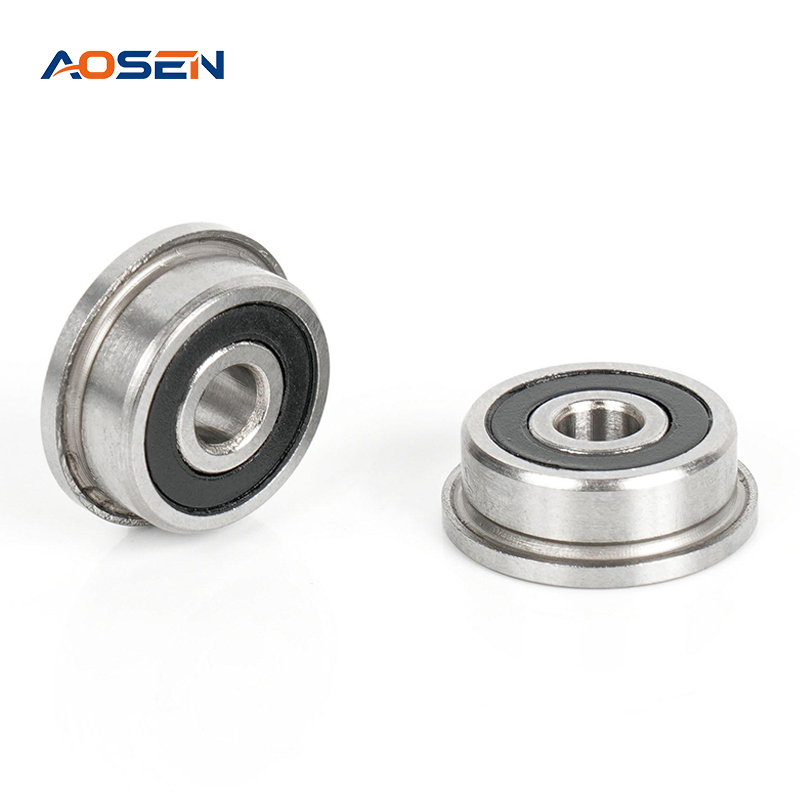
Flanged ball bearings are the most prevalent subtype. They use a deep groove ball bearing insert within the flanged housing and are suited for moderate radial loads with some axial capacity. Other flange bearing types include flanged roller bearings for high-load applications and flanged sleeve bearings for low-speed, oscillating motion.
Flange Bearing Housing Styles by Bolt Pattern
- 2-bolt flange (UCF / UCFL series): Oval or square base with two mounting holes; compact and suitable for lighter loads
- 3-bolt flange (UCFS series): Triangular pattern for more stable mounting and higher torque resistance
- 4-bolt flange (UCFB / UCFX series): Square pattern; highest rigidity and load capacity among flange types
- Cartridge / take-up flange units: Allow shaft position adjustment for belt tensioning
Pillow Block vs Flange Bearing: Direct Comparison
The table below summarizes the most critical practical differences between pillow block and flange bearings to guide selection:
Side-by-side comparison of pillow block and flange bearing units across key selection criteria
| Criteria |
Pillow Block Bearing |
Flange Bearing |
| Shaft orientation |
Parallel to mounting surface |
Perpendicular to mounting surface |
| Mounting surface |
Horizontal base / frame |
Vertical wall / panel / frame end |
| Primary load type |
Radial (high capacity) |
Radial + moderate axial |
| Footprint |
Larger; requires base clearance |
Compact; mounts flush to surface |
| Misalignment tolerance |
Up to 2–3° (self-aligning insert) |
Up to 2–3° (self-aligning insert) |
| Typical load range |
Medium to heavy |
Light to medium |
| Speed capability |
Moderate (up to ~3,000 rpm for ball inserts) |
Moderate to high (flanged ball bearings up to ~5,000 rpm) |
| Cost (standard sizes) |
$5–$80 per unit |
$4–$60 per unit |
| Typical applications |
Conveyors, fans, pumps, drive shafts |
Packaging machines, robotics, augers, HVAC |
Flanged Ball Bearings: Design Details and Performance Specs
Flanged ball bearings are the most widely used type of flange bearing in light-to-medium industrial and commercial applications. They consist of a deep groove ball bearing pressed or retained inside a flanged housing, usually made from cast iron or ductile iron, with an inner ring that grips the shaft via a set screw, eccentric collar, or adapter sleeve.
Standard flanged ball bearing inserts (UCF series) are manufactured to ISO and ABEC standards. A UCF205 unit, for example, accommodates a 25mm shaft diameter, has a static load rating (C0) of approximately 7.8 kN and a dynamic load rating (C) of around 14 kN, with a maximum operating speed of 4,800 rpm when grease-lubricated.
Key Design Features of Flanged Ball Bearings
- Self-aligning outer ring: Spherical outer surface compensates for up to ±2° of angular misalignment between shaft and housing
- Pre-lubricated and sealed: Most units come with double-contact rubber seals (2RS) and factory-packed grease; re-lubrication intervals of 6–12 months in normal conditions
- Locking mechanisms: Set screw (simpler, lower cost), eccentric locking collar (better for reversing loads), or adapter sleeve (for metric shafts in inch housings)
- Housing materials available: Gray cast iron (standard), ductile iron (higher impact resistance), stainless steel (washdown environments), glass-filled nylon (lightweight, corrosion-resistant)
UCF Flanged Ball Bearing Size Reference
Common UCF series flanged ball bearing specifications for standard shaft sizes
| Unit |
Shaft Bore |
Dynamic Load (C) |
Static Load (C0) |
Max Speed (rpm) |
| UCF201 |
12mm |
6.8 kN |
3.4 kN |
6,700 |
| UCF204 |
20mm |
12.8 kN |
6.2 kN |
5,400 |
| UCF205 |
25mm |
14.0 kN |
7.8 kN |
4,800 |
| UCF208 |
40mm |
25.5 kN |
15.3 kN |
3,400 |
| UCF211 |
55mm |
43.6 kN |
29.0 kN |
2,400 |
Load Direction: The Most Critical Selection Factor
The direction and type of load acting on the shaft is the single most important factor when choosing between pillow block and flange bearings. Getting this wrong causes accelerated wear, early fatigue, and catastrophic failure.
Radial Load Applications
Radial loads act perpendicular to the shaft axis — the weight of a belt, pulley, or gear pressing down on the shaft. Both pillow block and flange bearings handle radial loads, but pillow blocks generally carry higher radial loads because their housing geometry distributes force more effectively through the base. A standard UCP208 pillow block (40mm bore) has a dynamic radial load rating of approximately 25.5 kN, comparable to a UCF208 flange bearing of the same insert size.
Axial (Thrust) Load Applications
Axial loads act parallel to the shaft axis — for example, the end thrust of a screw conveyor or the force from a helical gear set. Flange bearings mounted on end plates or frame faces are naturally better positioned to resist axial loads because the mounting flange is perpendicular to the shaft, allowing the housing to directly brace against thrust. Pillow blocks resist axial loading less efficiently because the force acts along the shaft rather than into the base.
Combined Load Situations
Many real-world applications involve combined radial and axial loads. In these cases, engineers use the equivalent dynamic bearing load formula: P = X·Fr + Y·Fa, where Fr is radial force, Fa is axial force, and X and Y are bearing-specific factors from the manufacturer's catalog. If the axial-to-radial load ratio exceeds 0.3, flange bearings with angular contact inserts or paired arrangements should be considered.
Mounting Orientation and Space Constraints
Installation geometry is the second major differentiator between the two bearing types. The physical layout of a machine often dictates the only viable option regardless of load preferences.
- Shaft exits through a wall or panel: A flange bearing mounts directly on the panel with the shaft passing through. A pillow block cannot perform this function without a separate mounting bracket.
- Shaft runs across an open frame: Pillow blocks bolt to the frame rails on either side — the ideal use case with no wall to anchor against.
- Vertical shaft: Flange bearings mounted on a horizontal surface (shaft pointing up) are more practical; pillow blocks in vertical applications require custom modifications or specialized vertical-mount housings.
- Limited overhead clearance: Pillow blocks add height above the shaft centerline (a UCP205 stands approximately 44mm tall above the base); flange bearings protrude in the axial direction instead, saving vertical space.
- Multiple bearing points on a single shaft: Use one fixed pillow block or flange bearing on each end; never constrain both ends rigidly — one must be a floating (free) unit to allow thermal expansion.
Shaft Misalignment: How Both Types Handle It
Both pillow block and flange bearings typically use self-aligning insert bearings — the outer race has a convex spherical surface that rocks within the housing's concave bore. This design accommodates static misalignment caused by imprecise shaft installation, deflection under load, or thermal distortion.
Standard UC-series inserts (used in both UCP pillow blocks and UCF flange bearings) tolerate angular misalignment of ±2° to ±3°. However, this is static compensation — if dynamic misalignment (vibration-induced wobble) exceeds 0.5°, bearing life drops sharply. For high-misalignment applications, spherical roller inserts or spherical plain bearings should replace ball inserts.
Misalignment affects flange bearings slightly more in practice because end-mounted flanges amplify angular error — a 0.1mm perpendicularity error in the mounting panel translates directly to shaft misalignment. Always verify panel flatness (within 0.05mm per 100mm) before installing flange bearings on critical shafts.
Speed, Temperature, and Environmental Considerations
Operating environment significantly impacts bearing selection beyond just load and orientation. Both pillow block and flange bearing housings must match the application's speed, temperature range, and contamination exposure.
Speed Limits
Flanged ball bearings generally achieve higher speed ratings than equivalently sized pillow block units using roller inserts. A UCF205 flanged ball bearing runs to 4,800 rpm with grease lubrication, while a roller-insert pillow block of similar bore is limited to around 2,000–2,500 rpm. For high-speed spindles or fans above 3,000 rpm, flanged ball bearings are usually the better choice.
Temperature Range
Standard grease-filled UC insert bearings operate reliably from −20°C to +120°C. High-temperature grease extends this to +160°C. Above 120°C, seals degrade and grease oxidizes rapidly — consider open bearings with external oil lubrication for sustained high-temperature operation. At sub-zero temperatures below −20°C, synthetic low-temperature grease is mandatory to prevent grease channeling and starvation.
Contamination and Washdown
- Food and beverage / pharmaceutical: Specify stainless steel or NSF-certified thermoplastic housings with FDA-compliant grease in both pillow block and flange configurations
- Dusty or abrasive environments: Choose units with triple-lip seals or labyrinth shields; re-lubricate at shorter intervals (every 250–500 operating hours)
- Wet or outdoor exposure: Use sealed (2RS) inserts with corrosion-inhibiting grease; avoid open housings that pool water around the seals
- Chemical exposure: Cast iron housings are vulnerable to acids and caustics; thermoplastic (nylon or polypropylene) housings resist most chemicals effectively
Installation Best Practices for Both Bearing Types
Incorrect installation is the leading cause of premature bearing failure, responsible for over 50% of bearing failures according to major bearing manufacturers including SKF and NSK. Following proper procedures extends service life dramatically.
Pillow Block Installation Steps
- Clean and level the mounting surface; check flatness within 0.1mm per 200mm of bearing span
- Slide both housings onto the shaft loosely before bolting down — this allows the shaft to find its natural centerline
- Tighten mounting bolts to the specified torque (e.g., M10 bolts to ~40 Nm for cast iron housings)
- Lock the set screws or eccentric collar on the fixed-end bearing first, then the floating end
- Rotate the shaft by hand to verify smooth, drag-free movement before running under power
Flange Bearing Installation Steps
- Verify the mounting panel is perpendicular to the shaft centerline within 0.05mm per 100mm
- Insert the shaft through the housing before mounting the flange to the panel to avoid forcing misalignment
- Use all available bolt holes and tighten in a cross pattern to ensure even flange seating
- Leave the set screw or locking collar loose until both ends of the shaft are positioned, then lock the fixed end
- Apply a small amount of fresh grease through the grease port (if present) after installation to purge any contamination introduced during handling
How to Choose: Decision Guide by Application
Use this practical guide to identify the right bearing type based on your specific application scenario:
Application-based selection guide for pillow block vs flange bearing and flanged ball bearing units
| Application Scenario |
Recommended Type |
Reason |
| Conveyor drive shaft on open frame |
Pillow block |
Shaft is horizontal; high radial load from belt tension |
| Auger or screw conveyor end bearing |
Flange bearing (4-bolt) |
Mounts on end plate; handles axial thrust from screw action |
| Packaging machine cam shaft |
Flanged ball bearing (UCF) |
Compact; moderate speed; mounts on machine panel |
| Agricultural grain elevator |
Pillow block (roller insert) |
Heavy radial loads; shaft spans wide frame; dusty environment |
| HVAC fan shaft, high speed |
Flanged ball bearing |
Higher rpm rating; lower friction at speed |
| Food processing washdown line |
Stainless flange or pillow block |
Corrosion resistance; hygienic housing design |
| Vertical shaft pump |
Flange bearing (2-bolt or 4-bolt) |
Horizontal mount surface; shaft exits vertically through flange |
Maintenance, Relubrication, and Service Life Expectations
Both pillow block and flange bearing units share similar maintenance requirements because they typically use the same UC-series insert bearing. The key variable is accessibility, which often differs based on where the unit is mounted.
- Relubrication interval: Under normal conditions (ambient temperature, moderate speed, clean environment), re-grease every 1,000–2,000 operating hours or every 6 months, whichever comes first
- Grease quantity: Overfilling is as damaging as starvation — add grease slowly until slight resistance is felt at the relief valve or until fresh grease appears at the seal lip, then stop
- Insert replacement: UC-series inserts are replaceable without replacing the housing — a significant cost advantage, as insert cost is typically 30–50% of the complete unit cost
- Bearing life calculation: Use the L10 life formula: L10 = (C/P)³ × (10⁶/60n) hours, where C is dynamic load rating, P is equivalent dynamic load, and n is speed in rpm
- Warning signs: Unusual noise (clicking, grinding), elevated housing temperature above 80°C, visible grease leakage past seals, or excessive shaft runout all indicate imminent bearing failure
Under properly sized, well-lubricated conditions, flanged ball bearings and pillow block ball-insert units can achieve L10 service lives of 20,000–50,000 hours. Roller insert pillow blocks in heavy-duty applications routinely exceed 80,000 hours when maintained correctly.

 Español

 +86-15990593443
 No. 558 Huancheng West Road, Zhouxiang Town, Cixi City, Ningbo Province, Zhejiang Province