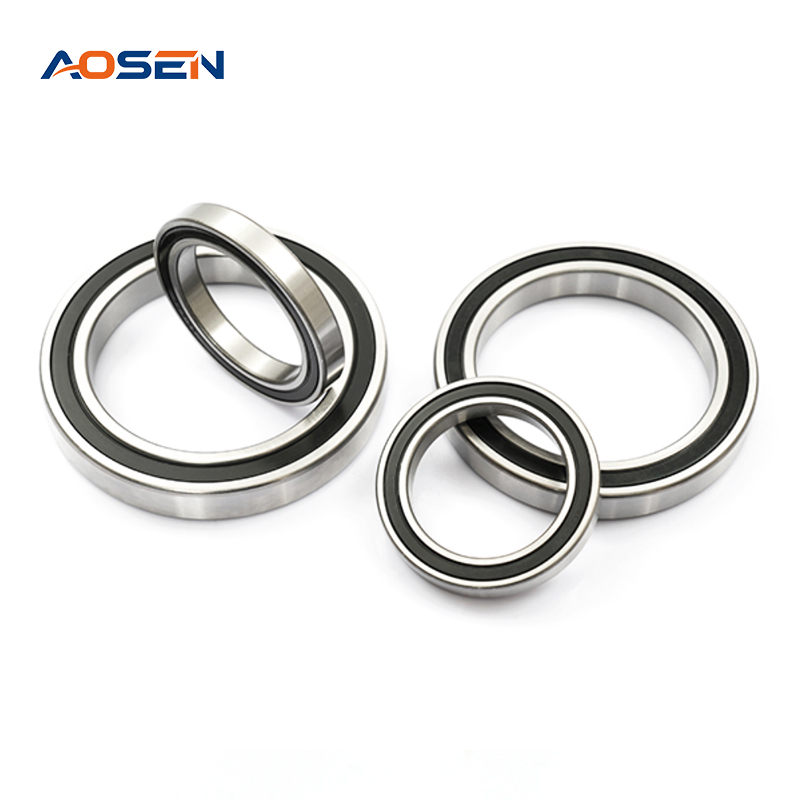
Deep groove ball bearings are not a special subtype — they are the most common "normal" bearing in the world. When engineers and buyers compare "deep groove vs normal bearings," the distinction is actually between deep groove ball bearings (the standard single-row radial bearing most people encounter) and other bearing types: shallow groove, angular contact, cylindrical roller, tapered roller, and thrust bearings. Deep groove ball bearings dominate because they handle both radial and axial loads, run at high speeds, require minimal maintenance, and are available in thousands of standardized sizes at low cost. For the vast majority of rotating applications, a deep groove ball bearing is the normal bearing.
What Makes a Deep Groove Ball Bearing "Deep Groove"
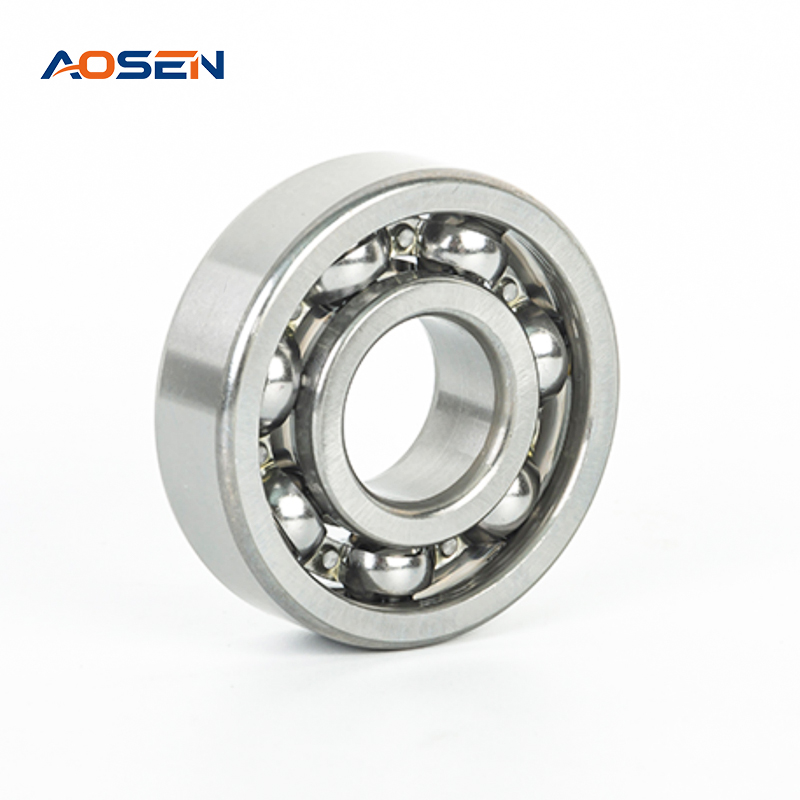
The defining feature of a deep groove ball bearing is the geometry of its raceways. Both the inner and outer rings have continuous, uninterrupted grooves that are deeper than the ball radius — typically the groove depth is about 25–35% of the ball diameter. This deep, close-conforming contact geometry is what gives the bearing its name and its performance characteristics.
In a shallow-groove or conrad-style bearing, the groove depth is reduced, which makes assembly easier but limits the load angle the bearing can sustain. In a deep groove design, the ball seats deeply into the raceway, producing:
- A larger contact arc between ball and raceway (typically 25°–35° contact angle under axial load)
- Higher radial load capacity relative to bearing size
- Meaningful axial (thrust) load capacity in both directions
- Lower friction torque at high speeds compared to roller bearings of equivalent size
The ISO 6200 series defines the standardized dimensions for single-row deep groove ball bearings. A 6205 bearing, for example, has a 25mm bore, 52mm outer diameter, and 15mm width — dimensions recognized and interchangeable across every bearing manufacturer worldwide.
Deep Groove Ball Bearings vs Other Common Bearing Types
To understand where deep groove ball bearings excel and where they fall short, it helps to compare them directly against the other major types a designer might consider:
| Bearing Type |
Radial Load |
Axial Load |
Max Speed |
Misalignment Tolerance |
Typical Cost |
| Deep Groove Ball |
High |
Moderate (both directions) |
Very High |
Low |
Low |
| Angular Contact Ball |
High |
High (one direction) |
High |
Very Low |
Medium |
| Cylindrical Roller |
Very High |
None / Very Low |
High |
Very Low |
Medium |
| Tapered Roller |
Very High |
Very High (one direction) |
Moderate |
Very Low |
Medium–High |
| Self-Aligning Ball |
Moderate |
Low |
High |
High (up to 3°) |
Low–Medium |
| Thrust Ball |
None |
High (one direction) |
Low |
Very Low |
Low–Medium |
Table 1: Deep groove ball bearings compared against other major bearing types across key performance parameters
The table reveals the core trade-off: deep groove ball bearings offer the best combination of radial load, axial load, and speed in a single, inexpensive unit. Other bearing types outperform them in one specific area but usually at the cost of flexibility, speed, or price.
Load Capacity: How Deep Groove Bearings Compare in Real Numbers
Load ratings are the most concrete measure of bearing capability. Using the ubiquitous 6205 bearing (25mm bore) as a reference point illustrates how deep groove bearings stack up against roller alternatives of identical bore size:
| Bearing |
Bore × OD × Width |
Dynamic Load C (kN) |
Static Load C₀ (kN) |
Limiting Speed (rpm) |
| 6205 (Deep Groove Ball) |
25×52×15 mm |
14.0 |
6.95 |
13,000 |
| NU205 (Cylindrical Roller) |
25×52×15 mm |
22.4 |
17.0 |
11,000 |
| 7205 (Angular Contact Ball) |
25×52×15 mm |
14.8 |
7.65 |
12,000 |
| 30205 (Tapered Roller) |
25×52×16.25 mm |
29.5 |
28.0 |
6,700 |
Table 2: Load ratings and speed limits for 25mm bore bearings of different types (representative SKF/FAG catalog values)
The data makes the trade-off clear: the cylindrical roller bearing carries 60% more radial load than the deep groove ball bearing at the same size, but cannot handle axial loads at all and has a lower speed limit. The tapered roller bearing more than doubles the static load capacity but its speed limit is nearly half. The deep groove ball bearing's 14.0 kN dynamic rating is more than adequate for the majority of applications — and it does so while also handling axial thrust, running faster, and costing less.
When Deep Groove Ball Bearings Are the Right Choice
Deep groove ball bearings are the optimal selection across a remarkably wide range of conditions. Choose them when:
- Combined radial and axial loads are present — the deep groove geometry handles both simultaneously without needing a separate thrust bearing.
- High rotational speed is required — deep groove ball bearings can operate at 10,000–30,000+ RPM depending on size and lubrication, far exceeding roller bearing limits at the same bore.
- Low noise and vibration are critical — precision-ground deep groove bearings in ABEC-5 or ABEC-7 tolerances are the standard in electric motors, spindles, and medical devices.
- Sealed, maintenance-free operation is needed — deep groove bearings are widely available with integral rubber (2RS) or metal (ZZ) seals, pre-packed with grease for life.
- Cost and availability matter — standardized ISO series (6200, 6300, 6400) means off-the-shelf availability from dozens of manufacturers at prices ranging from $0.50 to $50 for most common sizes.
- Light to moderate load conditions apply — in general machinery, electric motors, fans, pumps, and conveyor systems, radial loads typically fall well within the deep groove ball bearing's capacity.
Real-World Applications of Deep Groove Ball Bearings
Deep groove ball bearings appear in virtually every rotating machine category:
- Electric motors: Both ends of virtually every AC induction motor, servo motor, and stepper motor use deep groove ball bearings as the default choice.
- Automotive: Alternators, water pumps, idler pulleys, starter motors, and electric power steering units.
- Household appliances: Washing machines, vacuum cleaners, refrigerator compressors, and power tools.
- Industrial machinery: Fans, blowers, centrifugal pumps, gearbox input and output shafts, conveyor rollers.
- Precision equipment: CNC spindles (in higher ABEC grades), medical imaging equipment, dental handpieces, laboratory centrifuges.
When to Choose a Different Bearing Type Instead
Despite their versatility, deep groove ball bearings are not always the best answer. Specific operating conditions call for specialist bearings:
Choose Angular Contact Ball Bearings When:
- High, sustained axial loads act in one direction (e.g., machine tool spindles, ball screws, thrust-heavy pumps).
- Preloaded bearing arrangements are required for stiffness — angular contact bearings are designed for back-to-back or face-to-face preloaded pairs.
- Contact angles of 15°, 25°, or 40° are needed to balance radial vs. axial load share.
Choose Cylindrical Roller Bearings When:
- Heavy radial loads dominate and axial loads are negligible — roller line contact provides far greater radial load capacity per unit size.
- Shaft thermal expansion must be accommodated — the floating inner ring design of NU/N-type cylindrical roller bearings allows axial displacement without load transmission.
- Applications include large electric motors, turbines, rolling mills, and heavy gearboxes.
Choose Tapered Roller Bearings When:
- Both very high radial and very high axial loads act simultaneously (e.g., automotive wheel hubs, bevel gear drives, crane hooks).
- The application can tolerate lower speeds in exchange for superior load capacity — tapered roller bearings in automotive wheel hubs typically operate below 3,000 RPM.
Choose Self-Aligning Ball Bearings When:
- Shaft misalignment or housing deflection exceeds 0.5° — the double-row self-aligning design accommodates up to 2°–3° of angular misalignment without edge loading.
- Agricultural equipment, textile machinery, and long shaft systems where precise alignment is difficult to maintain.
Deep Groove Ball Bearing Variants: More Than One Standard
Within the deep groove ball bearing family, several important variants serve specific needs:
Single Row vs. Double Row
Standard deep groove ball bearings are single-row (one set of balls). Double-row deep groove bearings (Series 4200, 4300) have two rows of balls in a single bearing, offering roughly 1.6× the radial load capacity of a single-row bearing of the same bore, with only a modest increase in width. They are used when load capacity must increase without changing the shaft diameter.
Open, Shielded, and Sealed Variants
- Open (no suffix): No shields or seals. Suitable where external lubrication is supplied and contamination is controlled. Allows maximum speed and lowest friction.
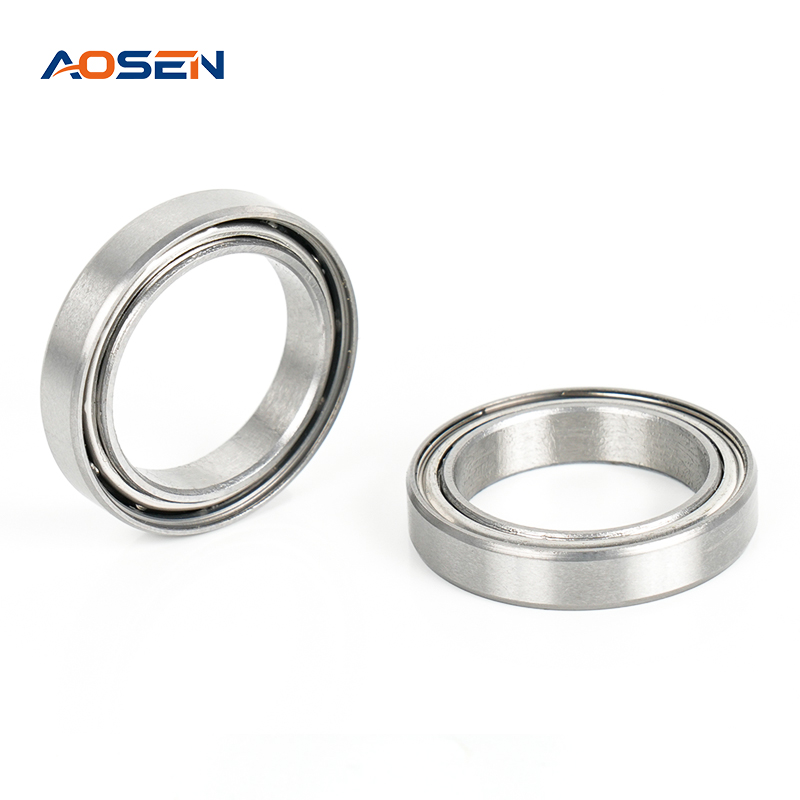
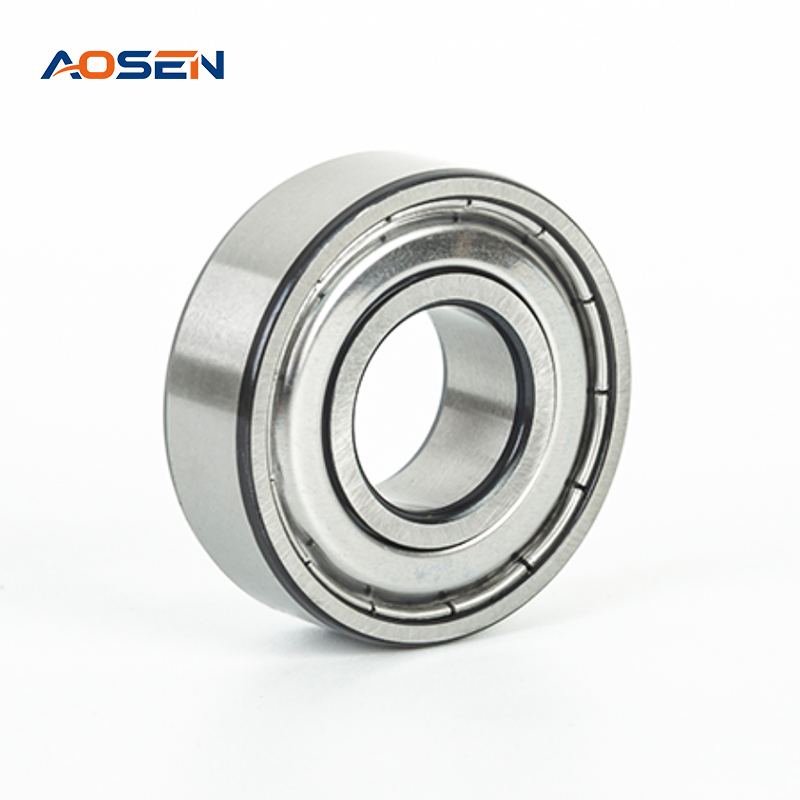
- Shielded (ZZ / Z): Metal shields on one or both sides. Retain grease and exclude coarse particles. Lower friction than rubber seals, but less effective contamination exclusion. Suffix: 6205ZZ.
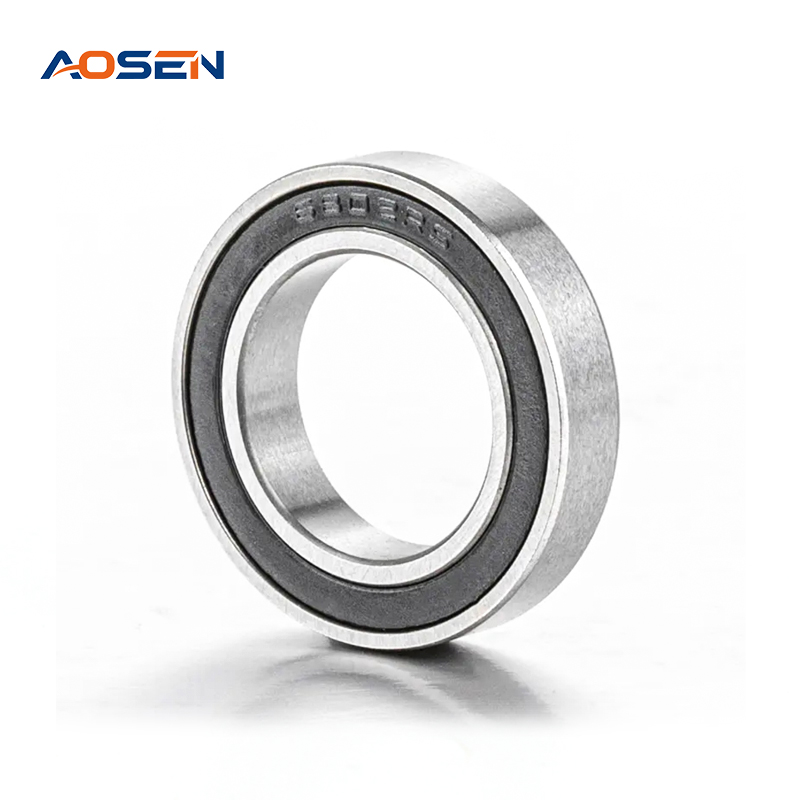
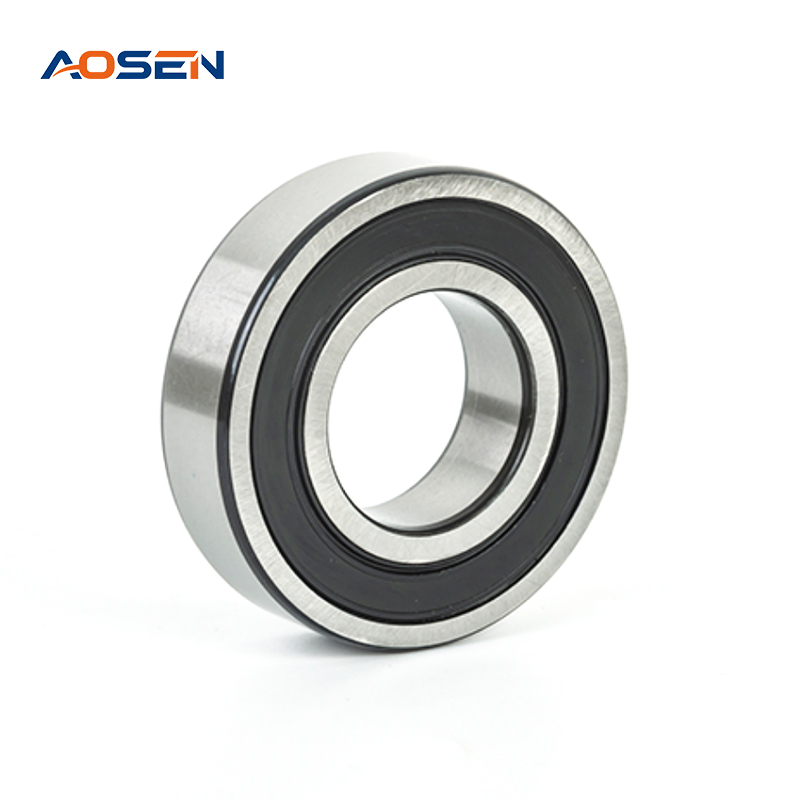
- Sealed (2RS / RS): Rubber contact seals on one or both sides. Excellent grease retention and contamination exclusion. Slight speed penalty (~10–20%) vs shielded variants due to seal drag. Suffix: 6205-2RS. The most common choice for maintenance-free applications.
Precision Grades (ABEC / ISO Tolerance Classes)
Deep groove ball bearings are manufactured to defined tolerance classes that determine dimensional accuracy, runout, and noise level:
- ABEC-1 / ISO P0: Standard tolerance. Suitable for general industrial use, electric motors, pumps. Most commodity bearings.
- ABEC-3 / ISO P6: Tighter tolerances. Reduced runout. Used in precision electric motors and moderate-speed spindles.
- ABEC-5 / ISO P5: High precision. Low noise and vibration. Standard in servo motors, robotics, and medical devices.
- ABEC-7 / ISO P4: Very high precision. CNC machine spindles, gyroscopes, aerospace instruments. Significantly higher cost.
For context: an ABEC-1 bearing might have a bore tolerance of ±12 µm, while an ABEC-7 bearing holds the same bore to within ±2.5 µm — tighter than a human hair diameter.
Key Specification Parameters When Selecting Deep Groove Ball Bearings
Specifying the correct deep groove ball bearing requires evaluating several interdependent parameters:
- Bore diameter (d): Must match shaft diameter. Standard bores from 3mm (623) to 200mm+ in the 6200/6300/6400 series.
- Dynamic load rating (C): The radial load that 90% of a bearing population can sustain for 1 million revolutions (ISO 281 definition). Size your bearing so the actual load stays well below C for longer life.
- Static load rating (C₀): Maximum allowable load when the bearing is stationary or oscillating slowly. Critical for shock-load applications.
- Speed rating: Two values are given — thermal reference speed (continuous operation limit) and limiting speed (absolute maximum). Select a bearing where your operating speed stays below 70–80% of the limiting speed for reliable service.
- Internal clearance (C2, CN, C3, C4): The amount of play between balls and raceways. Standard is CN (Normal). C3 clearance (larger than normal) is specified for applications where the bearing will run hot or the shaft fit is tight — both of which reduce operational clearance.
- Lubrication: Open bearings need regular re-lubrication. Sealed 2RS bearings come pre-greased with lithium-based grease suitable to approximately 120°C. High-temperature or food-grade applications require specialist greases specified at ordering.
- Material: Standard bearings use 52100 chrome steel. Stainless steel (440C) is available for corrosive environments. Ceramic hybrid bearings (steel rings, silicon nitride balls) offer higher speed and longer life for premium applications.
Bearing Life Calculation: How Long Will a Deep Groove Ball Bearing Last?
Bearing life is calculated using the ISO 281 basic rating life formula:
L₁₀ = (C / P)³ × 10⁶ revolutions — where C is dynamic load rating and P is the equivalent dynamic bearing load.
As a practical example: a 6205 bearing with C = 14.0 kN, loaded at P = 3.5 kN (25% of C rating), yields:
L₁₀ = (14.0 / 3.5)³ × 10⁶ = 64 × 10⁶ revolutions
Running at 1,500 RPM, this translates to approximately 711 hours of L₁₀ life — meaning 90% of bearings will survive this long under those conditions. Reduce the load to 15% of C and life increases by 8×. This cubic relationship explains why bearing life is extraordinarily sensitive to load: halving the load increases life 8-fold.
Modern bearing manufacturers use the modified rating life (L₁₀m) which incorporates lubrication, contamination, and material factors and typically predicts lives 3–10× longer than the basic formula under good operating conditions.
Practical Installation and Maintenance Guidelines
Even a correctly specified deep groove ball bearing will fail prematurely if installed or maintained incorrectly. The most important rules:
- Never apply installation force through the rolling elements. Always press on the ring being fitted (inner ring for shaft fits, outer ring for housing fits). Driving force through the balls causes immediate brinelling (denting) of the raceways.
- Use the correct shaft and housing tolerances. ISO recommends interference fits on the rotating ring and a sliding fit on the stationary ring. A typical shaft fit for a rotating inner ring is k5 or m5; housing fit for a stationary outer ring is H7.
- Do not over-grease. A bearing housing should be filled 30–50% full with grease by volume. Over-greasing causes churning, heat buildup, and accelerated wear.
- Check operating temperature. A well-functioning bearing typically runs 10–40°C above ambient. Temperatures above 70°C (158°F) signal over-loading, over-lubrication, contamination, or misalignment and need investigation.
- Use induction heaters for press-fit installation on shafts. Heating the bearing to 80–100°C expands the inner ring sufficiently for easy mounting without mechanical force — standard practice in motor manufacturing.
- Store bearings correctly. Keep in original packaging in a clean, dry location. Bearings stored horizontally on a shelf can develop false brinelling (vibration fretting damage) if exposed to external vibration during long storage periods.
Summary: Deep Groove vs Normal Bearings — The Bottom Line
Deep groove ball bearings are the normal bearing for most applications. Their combination of radial and axial load capacity, high-speed capability, wide availability in standardized dimensions, sealed maintenance-free variants, and low cost makes them the rational default choice across consumer electronics, industrial motors, automotive accessories, and precision instruments.
The situations where another bearing type is genuinely better are specific: extreme radial loads with no axial component (cylindrical roller), combined very heavy radial and axial loads at moderate speed (tapered roller), high precision one-direction thrust (angular contact), or significant shaft misalignment (self-aligning ball). Outside those defined conditions, a well-specified deep groove ball bearing — correctly sized, properly installed, and appropriately lubricated — will outlast and outperform alternatives in the overwhelming majority of real-world rotating applications.

 Español

 +86-15990593443
 No. 558 Huancheng West Road, Zhouxiang Town, Cixi City, Ningbo Province, Zhejiang Province